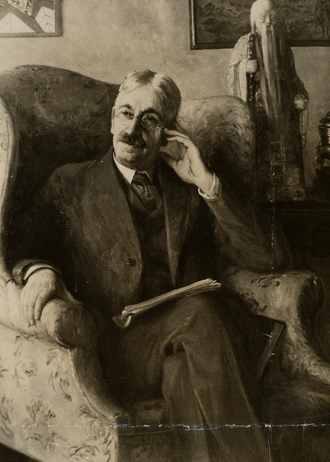
 AuthorJohn Dewey1859–1952
The School and Society collects the three lectures that John Dewey delivered in 1899 to raise funds for the Laboratory School he had founded at the University of Chicago. It was his first substantial work on education and became one of the most influential texts in twentieth-century educational thought. In the lectures Dewey outlines a psychological, social and political framework for progressive education, whose central element is collaborative practical experimentation within the school.
The first lecture considers the relationship between education and social progress. Dewey argues that industrialization removed many educative processes that had once taken place in the home, where children learned alongside their parents through real work, a practice that built character, independence and initiative. A new education, he insists, must be part of the broader social evolution rather than a set of isolated inventions devised by pedagogues. The school must become the child's new habitat, where he learns through directed living, and manual training, including woodwork, metalwork and cooking, holds a central place because it joins theory and practice.
The second lecture turns to the relation between schooling and the child's psychology. Dewey criticizes classrooms whose small, crowded desks allow only listening and reading, and he denounces a collective passivity inherited from a medieval conception of learning. In its place he proposes placing the child at the centre, drawing on natural impulses to communicate, build, inquire and express themselves artistically. He illustrates this with a cooking lesson that leads to questions of organic chemistry. He also answers those who fear that free inquiry will sacrifice discipline and needed information, contending that imagination and learning are not opposed faculties.
The third lecture addresses waste in education, which Dewey attributes mainly to isolation: between the successive stages of schooling, between the aims of education, and between its subjects and methods. His remedy is an organization in which the parts of the system connect coherently, so that the effort of pupils and teachers is not dissipated.
The work had considerable impact and laid the theoretical foundations of progressive education, which Dewey later developed in books such as Democracy and Education. Its influence persists in active pedagogy, project-based learning and reforms that link knowledge with experience.
Themes
Books to read
- The School and Society Being three lectures EnglishGutenberg
Other works by John Dewey
Original Filopedia text based on Wikipedia (en) and Wikidata.