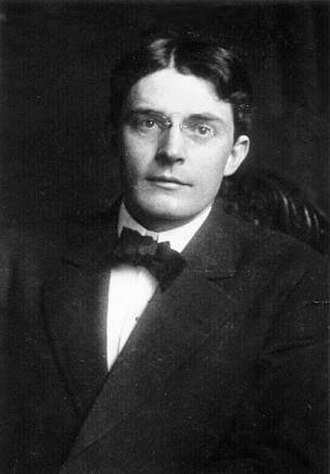
John B. Watson
1878–1958 · American psychologist, founder of behaviorism
Early life
John Broadus Watson was born on January 9, 1878, in Travelers Rest, South Carolina. His father, Pickens Butler Watson, was an alcoholic who left the family to live with two Indian women when John was thirteen, a betrayal the son never forgave. His mother, Emma Kesiah Watson, née Roe, was a deeply religious woman who observed strict prohibitions against drinking, smoking and dancing. She named her son after a prominent Baptist minister, hoping he would receive the call to preach the Gospel, and subjected him to harsh religious training. That upbringing left him with a lifelong hostility toward all forms of religion, and he eventually became an atheist.
To escape poverty, his mother sold the farm and moved the family to Greenville, South Carolina, a town of about 8,000 people. The move from an isolated rural place to a larger and more varied community proved important, since it gave him the chance to observe many different kinds of people, material he later used in developing his psychological ideas. The adjustment was hard, however, because his social skills were weak. The sources also record that he held racist views more extreme than most of his contemporaries, and that he was arrested for hate crimes against African Americans in the Greenville area, from which only his mother's influence with the local Baptist church saved him.
Education at Furman and Chicago
Despite poor grades and two arrests during high school, one for fighting and one for firing guns within the city limits, Watson gained admission to Furman University in Greenville at sixteen, through his mother's connections. There he took a few psychology courses without distinguishing himself, held campus jobs to pay for his studies, and was regarded by others as quiet, lazy and insubordinate. Because he was a precocious student, he nonetheless left Furman with a master's degree at twenty-one.
After graduating he spent a year at the Batesburg Institute, the name he gave to a one-room school in Greenville where he was principal, janitor and handyman. He then petitioned the university president to be admitted to the University of Chicago, a request that proved decisive, because there he met professors and colleagues who helped him turn psychology into a credible field of study. On the recommendation of a Furman professor he began studying philosophy with John Dewey. Under the combined influence of Dewey, James Rowland Angell, Henry Herbert Donaldson and Jacques Loeb, he developed a highly descriptive and objective approach to the analysis of behavior, which he would later call behaviorism. Wanting psychology to be scientifically acceptable, he treated the approach almost as an article of faith, believing that the right methodology could make psychology a scientific discipline. Later he became interested in Ivan Pavlov's work and included a much simplified version of Pavlov's principles in his popular writings.
His doctoral dissertation, completed at Chicago in 1903 and titled "Animal Education", was one of the first modern scientific studies of the behavior of the white rat. In it he described the relation between brain myelination and the learning ability of rats as they developed. He spent five years at Chicago studying the link between sensory input and learning, and found that the kinesthetic sense governed the behavior of rats running mazes. In 1908 he accepted a professorship at Johns Hopkins University, where he was soon made chair of the psychology department.
The behaviorist manifesto
In 1913 he published "Psychology as the Behaviorist Views It", often called the behaviorist manifesto, first delivered as an address at Columbia University. In it he defined psychology as a purely objective, experimental branch of natural science whose theoretical aim is the prediction and control of behavior. Introspection formed no essential part of its method, and the behaviorist saw no dividing line between humans and animals. Watson shifted the emphasis from inner mental states to observable behavior and to people's reactions in given situations, which he considered the only objective route to understanding human action. Combined with determinism, evolutionary continuity and empiricism, this outlook gave rise to what is often called methodological behaviorism, which should not be confused with Skinner's radical behaviorism.
Watson claimed that before Wilhelm Wundt there was no real psychology, and that after him there was only confusion, and that the new behaviorism would open a new era. He rejected the study of consciousness, which he considered inaccessible, and held that earlier attempts to study it had only hindered the discipline. He urged psychology to stop being the science of the "mind" and to focus instead on the behavior of the individual. The article also made a strong case for the scientific standing of applied psychology, which was then regarded as far inferior to established structuralist experimental psychology. At first Watson saw Pavlov's conditioned reflex mainly as a physiological mechanism controlling glandular secretions, and he rejected Edward Thorndike's law of effect because he judged its subjective elements unnecessary. Only in 1916 did he recognize the wider significance of Pavlov's formulation, and he made that subject the theme of his presidential address to the American Psychological Association.
Research and experiments
Watson's behaviorism rested on experiments with animals and with children. With Harvey A. Carr he carried out the experiment known as "Kerplunk", and with Rosalie Rayner he conducted the most controversial of his studies, the "Little Albert" experiment, which aimed to condition a fear response in a small child. He also worked on child rearing and on advertising, a field he regarded as a natural application of his principles. He edited the journal Psychological Review from 1910 to 1915. A 2002 survey published in the Review of General Psychology ranked him the seventeenth most cited psychologist of the twentieth century.
His well-known claim that, given a dozen healthy infants and a controlled environment, he could shape them into any kind of person was, by his own admission, an exaggeration.
Private life and the end of his academic career
While in graduate school he married Mary Ickes, sister of the politician Harold L. Ickes, and they had two children, both named John and Mary Ickes Watson. Later his wife sought a divorce after he began an affair with a student, Rosalie Rayner. Searching Rayner's bedroom, Mary found love letters from Watson. The affair became front-page news in Baltimore, and the publicity led Johns Hopkins University to ask him to resign his professorship in October 1920.
He then turned to advertising, working as a psychologist for the firms John Walter Thompson and William Esty Company. After the divorce he married Rayner in New Jersey in 1921. They had two sons, William Rayner Watson and James Broadus Watson, who were raised according to the behaviorist principles he championed. The couple stayed together until Rayner's death in 1935, at thirty-six. Afterwards Watson withdrew from his social circle and retired to his farm in Connecticut.
Final years and death
Watson burned much of his correspondence and personal papers, depriving historians of a valuable source for understanding the early history of behaviorism. The historian John Burnham interviewed him late in life and described a man of firm opinions and some bitterness toward his critics. In 1957, shortly before his death, he received the American Psychological Association's Gold Medal for his contributions to the field. He died in 1958, aged eighty, and was buried at Willowbrook Cemetery in Westport, Connecticut.
Legacy
Watson's influence on the history of psychology is undeniable. His 1913 article is regarded as the founding document of the behaviorist school. Yet behaviorism as a current would not have been possible without the work of Pavlov, who formulated classical or respondent conditioning, and of Thorndike, the forerunner of operant conditioning, whose influence on Burrhus Frederic Skinner would be decisive. Watson's achievement was to launch a school through a manifesto that stated explicitly the principles behaviorists should follow, with its emphasis on observable behavior and on the relation between stimulus and response.
Key ideas
- Behaviorism: psychology should study observable behavior rather than consciousness.
- Prediction and control: the goal of psychology is to predict and control behavior.
- Rejection of introspection: subjective reports do not form a reliable scientific method.
- Continuity across species: there is no clear dividing line between humans and animals when studying behavior.
Curiosities
An exaggerated claim
Watson claimed that with a dozen healthy infants and conditioning techniques he could shape them into any kind of person, but he later admitted that the claim was an exaggeration.
A controversial experiment
With Rosalie Rayner he carried out the Little Albert experiment, one of the most controversial studies of his career.
From the university to advertising
In 1920 Johns Hopkins University asked him to leave his chair after his relationship with Rayner became public, and he then worked as a psychologist in advertising.
Teachers and influences
Teachers
- John Dewey 1859–1952
Influenced
- B.F. Skinner 1904–1990
Original Filopedia text based on Wikipedia (es) and Wikipedia (en) and Wikidata.