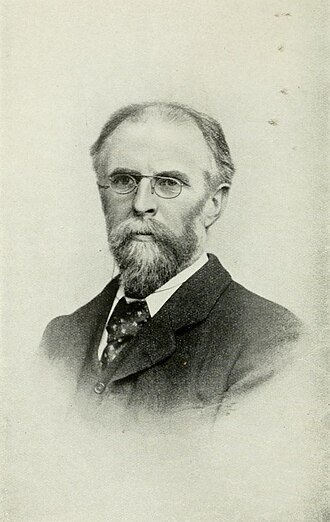
James Sully
1842–1923 · English psychologist and philosopher of the associationist tradition
James Sully (Bridgwater, 1842 – Richmond, 1923) was an English psychologist and philosopher who worked at the border between the philosophy of mind and the emerging scientific psychology. Raised in a Baptist family, he trained for the nonconformist ministry and studied at Göttingen and Berlin under Hermann Lotze and Hermann von Helmholtz. In 1871, however, he chose a literary and philosophical career instead.
Between 1892 and 1903 he held the Grote Chair of the Philosophy of Mind and Logic at University College London. He belonged to the associationist school, close in outlook to Alexander Bain, and wrote psychology textbooks, some among the first in English, such as The Human Mind (1892). His Illusions (1881) won praise from both Freud and Wundt, and his studies of childhood and laughter show his interest in mental development and emotion.
In 1898 he opened an experimental psychology laboratory at University College London, and in 1901 he was a founding member of the British Psychological Society. His lasting contribution lies in helping to establish psychology as an academic discipline in Britain, joining philosophical reflection with empirical observation.
Key ideas
- Associationism: mental life is built from sensations and ideas linked through experience.
- Illusions: perceptual errors reveal how the mind interprets sensory data.
- Developmental psychology: the study of childhood helps explain the origins of adult mental abilities.
- Pessimism: he examines disappointment and its place in human experience from a psychological standpoint.
- Laughter: he analyses humour as a psychological phenomenon tied to surprise and incongruity.
Books to read
- Studies of childhood EnglishEPUB 548 KBRead online
- An Essay on Laughter: Its Forms, Its Causes, Its Development and Its Value EnglishEPUB 442 KBRead online
- Illusions: A Psychological Study EnglishEPUB 323 KBRead online
Curiosities
From the pulpit to the lectern
Sully trained for the nonconformist ministry and worked as a classical tutor in Pontypool before turning to philosophy and literature.
Praise from Freud and Wundt
His 1881 book Illusions was commended by both Sigmund Freud and Wilhelm Wundt.
Original Filopedia text based on Wikipedia (es) and Wikipedia (en) and Wikidata.