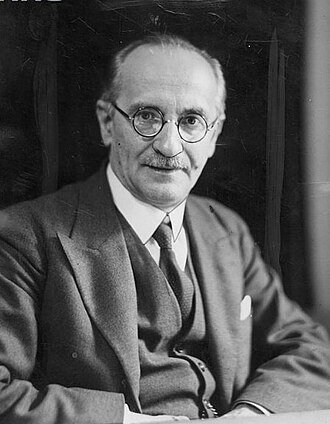
Jan Łukasiewicz
1878–1956 · Polish logician, mathematician and philosopher
Jan Łukasiewicz (Lviv, 1878 – Dublin, 1956) was a Polish logician, mathematician and philosopher and a central figure of the Lwów–Warsaw school. He is remembered above all for reshaping propositional logic, for the Polish notation and for being one of the first to build logical systems with more than two truth values.
He was born in Lemberg, then part of Austria-Hungary, the only child of an army officer and a civil servant's daughter. He studied in Lemberg under Kazimierz Twardowski, who gave him a demanding approach to philosophy and drew him towards mathematical logic. He earned his doctorate in 1902 with a thesis on induction and qualified for teaching in 1906. In those years he also studied in Berlin and Louvain, and he moved away from psychologistic accounts of logic.
After the First World War he took up a post at the University of Warsaw, where his lectures drew in young mathematicians. In 1919 he served as Polish Minister of Religious Denominations and Public Education, and he was twice rector of the university. Together with Stanisław Leśniewski he helped build the Lwów–Warsaw school, and his student Alfred Tarski later carried its work to an international audience.
His best-known contribution is three-valued logic, which he outlined in 1918 and presented formally in 1920. Examining future contingents, he argued that bivalence is not a logical necessity and that accepting it leads towards determinism. He therefore added a third value, possibility, to truth and falsehood, and later defended systems with infinitely many values. He also gave an elegant axiomatization of classical propositional logic.
During the German occupation he worked in clandestine teaching and, after the war, accepted an invitation from Éamon de Valera to settle in Dublin, where he remained until his death in 1956. His influence reaches the history of logic, many-valued logics and computing, where his notation inspired the use of stacks.
Key ideas
- Three-valued logic: adds possibility as a third value beside truth and falsehood, so that future contingents can be discussed without committing to determinism.
- Critique of bivalence: the law of excluded middle is not a fundamental logical truth, but an assumption tied to certain deterministic premises.
- Polish notation: placing operators before their arguments removes the need for brackets and simplifies logical formulas.
- Many-valued logics: the idea that logical systems can have more than two values, reaching in later work models with infinitely many values.
Curiosities
Diamond ring
In 1902 he received his doctorate under the patronage of Emperor Franz Joseph I, who gave him a ring set with diamonds for his outstanding results.
From logic to computing
His notation without brackets inspired the stack memory idea, used in the Burroughs B5000 computer of 1960 and in languages such as Lisp and Forth.
An asteroid named after him
A minor planet discovered by Paul G. Comba in 1998 was named 27114 Lukasiewicz in his honour.
Teachers and influences
Teachers
- Kazimierz Twardowski 1866–1938
Pupils
- Alfred Tarski 1901–1983
Original Filopedia text based on Wikipedia (es) and Wikipedia (en) and Wikidata.