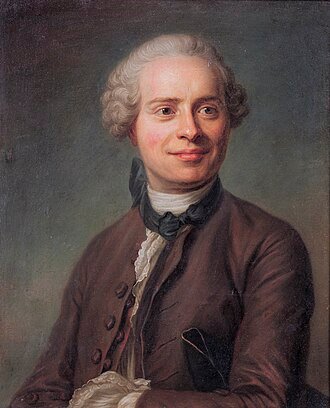
Jean Le Rond d'Alembert
1717–1783 · French mathematician, physicist and Enlightenment philosopher
Childhood and origins
Jean Le Rond d'Alembert was born in Paris on 16 November 1717, the illegitimate son of the writer Claudine Guérin de Tencin and the chevalier Louis-Camus Destouches, an artillery officer who was abroad at the time of the birth. Following custom, his mother left him on the steps of the church of Saint-Jean-le-Rond, from which he took his name. He was taken to a foundling home, but his father found him and placed him with the wife of a glazier, Madame Rousseau, with whom he lived for almost fifty years. She offered him little intellectual encouragement: when he told her of a discovery or something he had written, she generally replied with indifference.
Education
Destouches secretly paid for the boy's education without ever acknowledging his paternity. After an initial private school, at twelve d'Alembert entered the Jansenist Collège des Quatre-Nations, also known as the Collège Mazarin. There he studied philosophy, law and the arts, and graduated as baccalauréat en arts in 1735. The Jansenists tried to steer him toward an ecclesiastical career and away from poetry and mathematics; theology, however, struck him as rather thin fare. In later life he would scorn the Cartesian principles he had been taught there: physical promotion, innate ideas and vortices. He spent two years studying law, was admitted as an advocate in 1738, and also took an interest in medicine, a course he soon abandoned. He first enrolled as Jean-Baptiste Daremberg and later adopted the name d'Alembert, perhaps for reasons of euphony.
Early work and the Academy of Sciences
Mathematics was his great passion, learned almost entirely on his own. In July 1739 he sent the Académie des Sciences a communication pointing out errors in Analyse démontrée, a standard work he himself had used to study the foundations of the discipline. In 1740 he submitted a second paper, on the refraction of solid bodies, which Clairaut received with interest; in it he gave a theoretical explanation of refraction. After several failed attempts, in 1741 he was elected to the Académie des Sciences at the age of twenty-four. He later joined the Berlin Academy (1746) and became a Fellow of the Royal Society (1748).
The Traité de dynamique and the Encyclopédie
In 1743 he published his most famous work, the Traité de dynamique, in which he developed his own laws of motion and stated the principle that bears his name. The book made him known across Europe as one of the leading scientific thinkers of the age. In the late 1740s, when the Encyclopédie was organised, he became co-editor with Diderot in mathematics and science, a post he held until a series of crises temporarily halted publication in 1757. He wrote more than a thousand articles for it, including the celebrated Preliminary Discourse. In that text and elsewhere he took a sceptical view of whether anything outside us corresponds to what we think we perceive, close to Berkeley, and attacked the abuse of spiritual and temporal authority. The phrases "think for oneself" and "to think by oneself", later widely repeated, come from that discourse.
The break with Diderot in 1758 left the direction of the work to Diderot alone. Diderot later portrayed him in D'Alembert's Dream, an ironic dialogue on materialist philosophy. A controversy in 1757 over the clergy of Geneva, arising from an article of his, forced him to offer explanations and, after his reply to the critics, he withdrew from further work on the Encyclopédie.
Music and science
His first encounter with music theory came in 1749, when he was asked to review a memoir submitted by Jean-Philippe Rameau. Delighted by its deductive character, he presented it as a model of scientific method. In 1752 he published the Éléments de musique théorique et pratique suivant les principes de M. Rameau, which sought to clarify and simplify the composer's claims. Not being a musician, he misread some subtle points of Rameau's thought and altered others to fit his own understanding. The relationship deteriorated into bitter exchanges. In the Preliminary Discourse he also reflected on the state of music, which he thought less able than the other arts to represent reality.
In mathematical physics he studied vibrating strings and derived a partial differential equation describing their motion: the first example of the wave equation, which places him among the founders of mathematical physics. This work sparked a fruitful controversy with Euler and Daniel Bernoulli, from which it emerged that a trigonometric solution could be adapted to an arbitrary initial shape of the string. He also devised a criterion for distinguishing convergent from divergent series and gave an almost complete proof of the fundamental theorem of algebra, which in France is called the d'Alembert–Gauss theorem.
Academy and private life
He entered the Académie Française in 1754 and was made its permanent secretary on 9 April 1772, a post from which he wrote the eulogies of academicians who had died between 1700 and 1770. He frequented the salons of Marie Thérèse Geoffrin, the marquise du Deffand and Julie de Lespinasse, with whom he became deeply attached and eventually shared a home. He suffered from poor health for many years.
Death and legacy
He died in Paris on 29 October 1783, at the age of sixty-five, by then regarded as one of the most eminent thinkers of the French Enlightenment. Being known as an unbeliever, he was buried modestly in an unmarked common grave. Condorcet accompanied his funeral procession and praised him at the Academy. His name survives in d'Alembert's principle, in his ratio test for convergence, in the d'Alembert operator of modern theoretical physics, in the lunar crater that bears his name, and in the "d'Alembert system" of betting, which grew out of his mistaken view of probability in games of chance.
Key ideas
- d'Alembert's principle: the motion of a system can be treated as a balance between applied forces and inertial forces taken with the opposite sign.
- Wave equation: the vibration of a string is described by a partial differential equation, the first model of this kind of phenomenon.
- Enlightenment rationalism: knowledge should rest on reason and experience, with scepticism toward metaphysics and religious authority.
- Convergence test: a method for deciding whether an infinite series converges or diverges.
Curiosities
A name taken from a church
He was left on the steps of the Saint-Jean-le-Rond church in Paris, and he took his name from it, following the custom of the time.
A moon he declined
Frederick the Great of Prussia proposed his name for a suspected moon of Venus, which did not exist, but d'Alembert refused the honour.
A betting system
The betting strategy known as the d'Alembert system bears his name, although he was wrong to argue that the chance of heads grew after each tails.
Teachers and influences
Influenced
Original Filopedia text based on Wikipedia (es) and Wikipedia (en) and Wikidata.