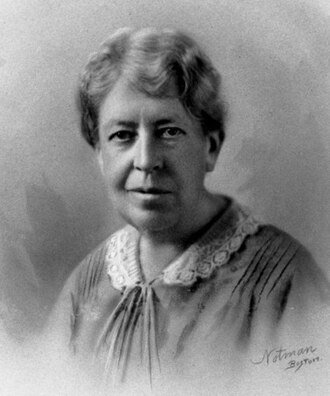
Mary Whiton Calkins
1863–1930 · American psychologist and philosopher, pioneer in the study of the self
Mary Whiton Calkins (1863–1930) was an American psychologist and philosopher who worked at the border between experimental psychology and metaphysics in the late nineteenth and early twentieth centuries. She matters chiefly for two reasons: in 1905 she became the first woman to preside over the American Psychological Association, and in 1918 the first woman to preside over the American Philosophical Association. She also devised a paired-associate method for studying memory and built a theory of the self that she tried to treat as a subject for scientific inquiry.
Raised in a devout, comfortably off family, she studied at Smith College and taught Greek at Wellesley College, a women's college where career options for women were narrow. In 1890 Wellesley asked her to teach psychology, on condition that she first spend a year learning the subject. Harvard did not admit women as regular students, so she attended lectures as an invited guest, first with William James and Josiah Royce and later with Hugo Münsterberg. In 1891 she set up one of the earliest experimental psychology laboratories at a women's college, at Wellesley. Her 1895 doctoral dissertation, An Experimental Research on Association of Ideas, was judged by examiners including James and Royce to be of the highest standard, yet Harvard never granted her the degree, and it refused again in 1927.
Her early papers of the 1890s examined memory through the paired-associate technique, in which a subject learns pairs of items and is later shown one member of a pair and asked to recall the other. From 1900, beginning with her article "Psychology as Science of Selves", she turned to the self, which she argued could be studied as a fact in its own right. She described it as a single, changing identity, as a bundle of perceptions, memories, thoughts and feelings, and as something located within a physical and social community. Her thinking drew on James and on Royce, for whom a sense of personal identity arose through social life. Calkins taught at Wellesley until her retirement in 1929 and died in 1930 without Harvard ever recognising her doctorate, a recognition that Harvard would not extend to women until 1963. Today she is remembered as an early contributor to the psychology of the self and as a pioneer of women's place in academic life.
Key ideas
- Paired-associate learning: an experimental technique for studying memory by learning pairs of related items.
- Psychology of the self: the proposal that the self can be treated as an observable fact open to scientific study, not only as a metaphysical question.
- The self as changing unity: the self is both a persisting identity and a union of perceptions, memories, thoughts and feelings.
- The social self: the self takes shape in relation to the physical and social community in which a person lives.
Curiosities
A guest, not a student
Harvard allowed her to attend classes as an invited guest rather than a registered student, after her father and Wellesley's president wrote on her behalf.
A study of dreams
Together with Edmund Sanford she recorded her own dreams upon waking over a seven-week period; she logged 205 dreams and he logged 170.
Teachers and influences
Teachers
- William James 1842–1910
- Josiah Royce 1855–1916
Original Filopedia text based on Wikipedia (es) and Wikipedia (en) and Wikidata.