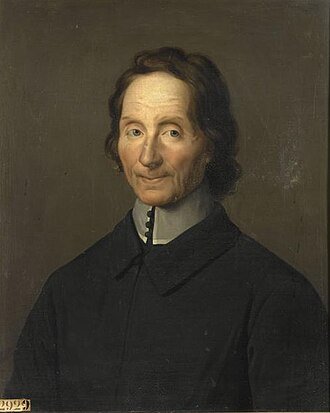
Nicolas Malebranche
1638–1715 · French Oratorian priest and rationalist philosopher
Nicolas Malebranche (Paris, 1638 – Paris, 1715) was a French priest of the Oratory and rationalist philosopher. He set out to combine the thought of Saint Augustine with that of Descartes, aiming to show that God is actively involved in every aspect of the world. He is best remembered today for his doctrine of occasionalism and for the claim that we see all things in God.
Born into a well-off Parisian family, he was the youngest child and had poor health from an early age, partly because of a malformed spine, so he was taught at home by a private tutor. At sixteen he left home to study philosophy at the Collège de la Marche and then theology at the Sorbonne, but he came away disappointed with scholastic methods. In 1660 he joined the Congregation of the Oratory, where he studied church history, the Bible and the works of Augustine, and he was ordained a priest in 1664. That same year he read Descartes' Treatise on Man, a book that shaped his thinking for the following decade.
His main work, The Search after Truth (1674–75), grew considerably after many objections, especially those of Simon Foucher. In its third book he argued that the ideas through which we perceive objects exist in God. In his occasionalist account, bodies and minds are independent substances that do not act on one another directly. What we call a cause is only an occasion, and God is the one true cause of change: when I want to move my arm, God moves the body on the occasion of my will. To explain sensory perception, he held that ideas represent geometrical properties such as size, shape and motion, while sensations supply colour and other qualities, which make a universal idea refer to a particular thing.
His other major works include the Christian and Metaphysical Meditations (1683) and the Treatise on Nature and Grace (1680). The latter drew a fierce response from Antoine Arnauld, starting a long controversy, and it was placed on the Index of Prohibited Books in 1690. Malebranche died in Paris in 1715, at the age of seventy-seven.
His influence was significant. His analysis of causation was a starting point for David Hume, who discussed it in his Treatise of Human Nature, and his idea that the mind cannot know the world on its own shaped debates that reached into modern epistemology.
Key ideas
- Occasionalism. God is the only true cause; created things are merely occasions for his action.
- Seeing all things in God. The ideas through which we know things exist in God, and so they are eternal and unchanging.
- A synthesis of Augustine and Descartes. He joins the Augustinian tradition to the Cartesian rationalist method.
- Substances without direct interaction. Body and mind are independent and communicate only through divine action.
Curiosities
Fragile health
From childhood he had poor health and a malformed spine, so he received his early education from a private tutor.
Books on the Index
The Treatise on Nature and Grace was placed on the Index of Prohibited Books in 1690, and The Search after Truth followed in 1709.
Leaving the Sorbonne
Having rejected scholasticism, he left the Sorbonne and joined the Congregation of the Oratory in 1660.
Teachers and influences
Influenced by
- René Descartes 1596–1650
- Augustine of Hippo 354–430
Influenced
- Voltaire 1694–1778
- Immanuel Kant 1724–1804
- Gottfried Wilhelm Leibniz 1646–1716
- Benedictus de Spinoza 1632–1677
- George Berkeley 1685–1753
- Louis-Claude de Saint-Martin 1743–1803
Original Filopedia text based on Wikipedia (es) and Wikipedia (en) and Wikidata.