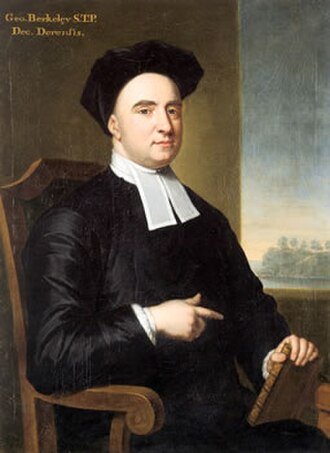
George Berkeley
1685–1753 · Irish empiricist philosopher, Anglican bishop and founder of immaterialism
Origins and education
George Berkeley was born in 1685 at Dysert, near Thomastown in County Kilkenny, Ireland. He was the eldest son of William Berkeley, a member of a family of English origin with roots in Gloucestershire. He was educated at Kilkenny College before entering Trinity College Dublin, where he won a scholarship in 1702, took his bachelor's degree in 1704 and, three years later, his master's along with a junior fellowship. He stayed on at the college as a librarian, lecturer in Greek and preacher.
Early works and the theory of vision
His first publication was on mathematics, but the work that brought him notice was An Essay towards a New Theory of Vision, published in 1709. In it he examined how we perceive distance, size and position, and the relation between sight and touch, arguing that the proper objects of sight are light and colour rather than material things. The book provoked considerable controversy at the time, though many of its conclusions are now part of the established science of optics. That same year he was ordained a priest without consulting the Archbishop of Dublin, which led to a court case.
Immaterialism
In 1710 he published A Treatise Concerning the Principles of Human Knowledge, where he set out his central claim: that the physical world consists of ideas perceived by the mind and cannot exist without being perceived. The formula "to be is to be perceived" sums up the position, which he called immaterialism and which later generations have known as subjective idealism, a label Berkeley himself did not use. He directed his criticism against the notion of material substance, which he regarded as an empty abstraction. The reception was poor, since few were prepared to accept that nothing exists outside the mind. Three years later, in 1713, he recast his ideas as Three Dialogues Between Hylas and Philonous. Philonous, the "lover of mind", speaks for Berkeley, while Hylas, whose name derives from the Greek word for matter, stands for his opponents, above all John Locke. The Treatise sets out the doctrine and the Dialogues defend it.
Travels, London and the American project
After the publication he visited England, where he was received into the circle of Addison, Pope and Steele. Between 1714 and 1720 he combined his academic work with long journeys through Europe, including one of the most extensive Grand Tours of Italy. In 1721 he took his doctorate in divinity and returned to Trinity College to teach divinity and Hebrew. The following year he became Dean of Dromore and, in 1724, Dean of Derry. In 1725 he gave up that deanery, with its income of £1,100, to found a college in Bermuda for training ministers and missionaries for the colonies. In 1728 he married Anne Forster and moved to Rhode Island on a salary of £100 a year, where he bought a plantation at Middletown, known as Whitehall, and several enslaved Africans to work it. This period requires a clear judgement: his sermons argued that Christianity permitted slavery and urged that enslaved people be baptised so that they would obey their masters. In 2023 Trinity College Dublin removed his name from one of its libraries for this reason. The funds promised for the college never arrived, and in 1732 he returned to London.
Bishopric and final works
In 1734 he was appointed Bishop of Cloyne in the Church of Ireland, a post he held until his retirement in 1752. In these years he published Alciphron, or the Minute Philosopher, a Christian apologetic against the free-thinkers and against Shaftesbury, and The Querist, a series of questions on economics and politics. His last books were Siris, on the medicinal virtues of pine-tar water, and Further Thoughts on Tar-water. The tar-water work sold more copies than any of his other books during his lifetime. Around 1752 he moved to Oxford to live with his son George, and he died there in January 1753. He was buried in Christ Church Cathedral.
Ideas, science and mathematics
Berkeley's interests went well beyond metaphysics. In De Motu, published in 1721, he criticised Newton's conception of absolute space, time and motion, and his arguments partly anticipated the views of Ernst Mach and Albert Einstein. In 1734 he published The Analyst, a critique of the foundations of the calculus, in which he coined the phrase "ghosts of departed quantities". Berkeley did not doubt that the calculus produced verifiable results, but he argued that it lacked rigorous foundations, and his criticism spurred the search for firmer bases that led to later work by Cauchy and Weierstrass.
Reception and legacy
His influence was profound. He is considered one of the founders of British empiricism, and his thought paved the way for David Hume, who took up his critique of material substance. Thomas Reid, after admiring his system for a long time, became one of its sharpest critics. Arthur Schopenhauer called him the father of idealism. In North America, Samuel Johnson, who visited him, adapted parts of his ideas into a school of thought of his own, and Berkeley gave Yale a considerable number of books and his plantation, greatly enriching the college's library. Interest in his work revived after the Second World War, because he addressed questions central to twentieth-century philosophy, such as perception, the distinction between primary and secondary qualities, and the role of language. The city of Berkeley in California and its university take their name from him.
Key ideas
- Immaterialism: to be is to be perceived or to perceive, so things are not a material substance but collections of ideas.
- Critique of abstraction: we have no clear idea of a material substance stripped of all sensible qualities, so positing one makes no sense.
- God as guarantor of existence: things go on existing when no one perceives them because a mind sustains them continuously.
- Vision: what sight immediately delivers are light and colour, not material objects.
- Critique of Newton and the calculus: absolute space, time and motion, along with the foundations of the calculus, lacked a secure basis.
Quotes
“to be is to be perceived or to perceive”
Tratado sobre los principios del conocimiento humano
Where to start
A Treatise Concerning the Principles of Human Knowledge 1710
It is the best entry point because it sets out directly and relatively briefly Berkeley's central thesis: that to be is to be perceived, and that matter as traditional philosophy imagines it does not exist. The reader will find clear arguments about ideas, the senses and the existence of God as guarantor of the reality of what is perceived.
Next: Three Dialogues between Hylas and Philonous. The Three Dialogues revisit these same ideas in dramatic conversational form, letting the reader see objections and replies more vividly and deepen the defence of idealism.
Works in Filopedia
Books to read
- A Treatise Concerning the Principles of Human Knowledge EnglishEPUB 144 KBRead online
- The Works of George Berkeley. Vol. 1 of 4: Philosophical Works, 1705-21 EnglishEPUB 682 KBRead online
- Three Dialogues Between Hylas and Philonous in Opposition to Sceptics and Atheists EnglishEPUB 137 KBRead online
- An Essay Towards a New Theory of Vision EnglishEPUB 132 KBRead online
Curiosities
A name on the map
The city of Berkeley in California, and the university around which it grew, were named in his honour.
The father of idealism
The German philosopher Arthur Schopenhauer called him 'the father of idealism'.
Teachers and influences
Influenced by
- John Locke 1632–1704
- Nicolas Malebranche 1638–1715
Influenced
- Immanuel Kant 1724–1804
- David Hume 1711–1776
- Henri Bergson 1859–1941
- Charles Sanders Peirce 1839–1914
- Ernst von Glasersfeld 1917–2010
Original Filopedia text based on Wikipedia (es) and Wikipedia (en) and Wikidata.