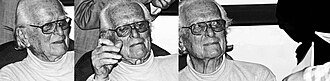
Ernst von Glasersfeld
1917–2010 · Austro-American philosopher and cyberneticist, founder of radical constructivism
Ernst von Glasersfeld (Munich, 1917 – Massachusetts, 2010) was a philosopher and cyberneticist who developed radical constructivism, an account of knowledge holding that we do not copy an independent reality but build our understanding from experience. His work bridges philosophy, cognitive psychology and cybernetics, and it has had a lasting effect on educational theory and the teaching of mathematics.
From a family of Austrian background, he spent his early years between Prague and South Tyrol and was schooled in Switzerland. He studied mathematics in Zurich and Vienna, but the rise of the Nazis and the seizure of his family's property forced him to abandon his studies. He took refuge in Ireland, where he worked as a farmer, and later in Italy, where he collaborated with the philosopher Silvio Ceccato on the artificial analysis of language. In 1962 he moved to the United States, where he taught psychology at the University of Georgia from 1970 until his retirement, and afterwards was a research associate at the University of Massachusetts Amherst.
His thinking draws on Piaget's genetic epistemology, Berkeley's theory of perception, and ideas from Vico and Vygotsky. For Glasersfeld, knowing means organising experience in a way that works, or is viable, for acting in the world, without guaranteeing a picture of reality as it is in itself. This led him to rethink traditional notions such as truth, knowledge and communication, with clear consequences for teaching: knowledge is not handed over but constructed by each learner.
He received the McCulloch Memorial Award from the American Society for Cybernetics in 1991 and an honorary doctorate from the University of Klagenfurt in 1997. His ideas remain influential in constructivist pedagogy and in debates about the nature of scientific knowledge.
Key ideas
- Radical constructivism: knowledge is an active construction by the knower rather than a mirror of an independent reality.
- Viability: a piece of knowledge is valid if it works in experience, even if it does not describe reality as it is in itself.
- Rejection of the transmission of knowledge: learning consists of building and discovering, not of receiving ready-made contents.
- Reframing key concepts: truth, knowledge and communication must be understood through experience and construction rather than correspondence with external objects.
Teachers and influences
Influenced by
- George Berkeley 1685–1753
Original Filopedia text based on Wikipedia (es) and Wikipedia (en) and Wikidata.