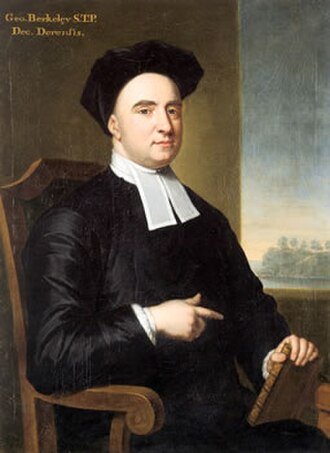
 AuthorGeorge Berkeley1685–1753
The Analyst is a work by George Berkeley first published in 1734, first in London and soon after in Dublin. Its full title presents it as a discourse addressed to an infidel mathematician, and that figure is usually identified with the astronomer Edmond Halley, although Isaac Newton has also been proposed. The book grew out of Berkeley's dispute with the free-thinkers: in 1732 he had published Alciphron, a series of dialogues against different kinds of unbelievers, including the secular scientist who trusted human reason without reservation. A mocking remark by Halley against these arguments led Berkeley to change his target and turn against mathematics the same tactics that free-thinkers used against religion.
Its main object is the calculus as developed by Newton, with his fluxions, and by Leibniz, with his infinitesimal increments. Berkeley points to what he regards as logical leaps in the demonstrations, in particular the procedure of assuming an increment, dividing by it, and then treating it as zero in order to keep the result. His conclusion is that the certainty of mathematics is no greater than that of religious mysteries, since both rest on notions beyond the reach of reason. Berkeley does not deny that the results of calculus are correct; he argues that they are reached through errors that cancel one another. His famous description of fluxions as "the ghosts of departed quantities" sums up the criticism.
The work was widely noticed. In 1736 Thomas Bayes published an anonymous defence of Newton's calculus, and in 1742 Colin Maclaurin wrote a treatise with the same aim. Although calculus continued to be developed for nearly a century without fully rigorous foundations, Berkeley's objections spurred the search for a firmer basis, which arrived with the limit definitions of Cauchy, Weierstrass and Riemann. Today his logical objections to the mathematical practice of his time are generally considered largely well founded.
Themes
Other works by George Berkeley
Original Filopedia text based on Wikipedia (en) and Wikidata.