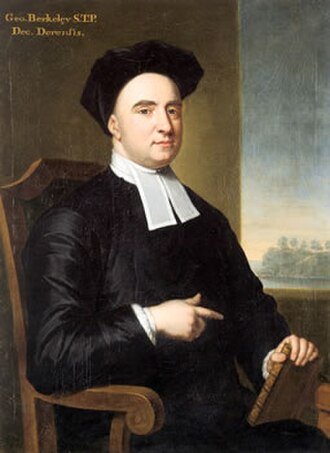
 AuthorGeorge Berkeley1685–1753
De Motu, whose full title is On Motion: or The Principle and Nature of Motion and the Cause of the Communication of Motions, is an essay by George Berkeley published as a pamphlet in London in 1721. Berkeley submitted it, without success, to a prize competition sponsored by the Royal Academy of Sciences in Paris, and in it he challenges at its root the notions of absolute space, time and motion championed by Isaac Newton.
The essay insists that the inquirer should attend to facts about things and their nature rather than to words or to authority. Berkeley allows that gravity and force can be useful terms, designating bodies in motion or a concrete effort of resistance, but warns against using them abstractly, detached from particular bodies. For him, notions such as force, attraction and the parallelogram of composite forces are mathematical and hypothetical abstractions rather than physical qualities. Bodies are passive and do not contain within themselves the cause of their motion. That ultimate cause is the mind of God, a matter for metaphysics and theology, while natural science is confined to experiment, the laws of motion and mechanical deduction.
Berkeley holds that motion and space are relative, since they always presuppose a relation to other bodies, and he suggests that motion might be considered relative to the fixed stars. Its ideas were later read with interest: the philosopher Karl Popper regarded Berkeley as a precursor of Ernst Mach and Albert Einstein in their critique of absolute concepts.
Themes
Other works by George Berkeley
Original Filopedia text based on Wikipedia (en) and Wikidata.