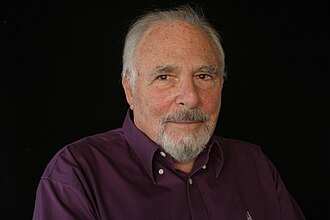
Paul Ekman
1934–2025 · American psychologist and pioneer in the study of emotion and facial expression
Paul Ekman (Washington, D.C., 1934 – San Francisco, 2025) was an American psychologist and a pioneer in the study of emotions and their expression on the face. Working from an evolutionary perspective that owed much to Charles Darwin, he helped restart the scientific study of emotion and nonverbal communication.
He grew up in a Jewish family, moving between New Jersey, Washington State, Oregon and California. He first wanted to become a psychotherapist, but his military service in the late 1950s showed him that research could improve the routines of an institution, and this pushed him toward research. He earned his doctorate in clinical psychology at Adelphi University in 1958. In 1972 he joined the University of California, San Francisco as a professor, retiring in 2004, after decades of funding from the National Institute of Mental Health.
His central contribution was the claim that certain facial expressions are universal. Against the view, common among anthropologists such as Margaret Mead, that gestures are learned culturally, he found that members of literate Western and Eastern cultures agreed when assigning emotion labels to faces, and that the same held for a people of Papua New Guinea. To describe facial movement he developed the Facial Action Coding System (FACS), and in the 1990s he expanded his list of basic emotions.
His work has also drawn criticism. Many researchers doubt that people can reliably spot lies just by looking at faces, and others found little experimental support for his taxonomy of discrete emotions. Still, his influence is wide: he inspired the television series Lie to Me and served as a scientific adviser to Pixar's film Inside Out (2015).
Key ideas
- Universality of basic emotions. Expressions of anger, disgust, fear, happiness, sadness and surprise would be recognized across cultures, which he took as evidence of a biological origin.
- Facial Action Coding System (FACS). It describes any observable facial movement through action units that can combine to form any expression.
- Microexpressions. Brief facial movements that appear when someone tries to conceal an emotion, which he argued could help detect lies with some reliability.
- Display rules. Cultural norms about who may show which emotion, to whom and when, which can mask the universal expression underneath.
Curiosities
University at fifteen
Without having finished high school, he enrolled at the University of Chicago at fifteen. His classmates there included writer Susan Sontag, director Mike Nichols and actress Elaine May.
From the army to research
His military service, where he saw that research could make army routines more humane, led him to give up his plan to become a psychotherapist and become a researcher instead.
Teachers and influences
Influenced by
- Charles Darwin 1809–1882
Original Filopedia text based on Wikipedia (es) and Wikipedia (en) and Wikidata.