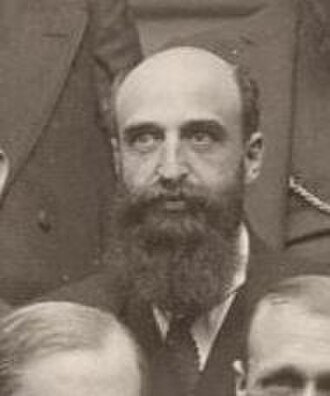
Paul Federn
1871–1950 · Austrian-American physician and psychoanalyst, an early disciple of Freud
Paul Federn (Vienna, 1871 - New York, 1950) was a physician and psychoanalyst and one of Freud's first followers. Despite his loyalty to the founder, he developed a distinct line of thought on psychosis, which gave him an original place within the psychoanalytic movement, although he remained little known during his lifetime.
The son of the Viennese physician Salomon Federn, he opened his own practice in 1902, and that same year he joined the circle that would later become the Vienna Psychoanalytic Society. After serving as a military doctor in the First World War, he published in 1919 Zur Psychologie der Revolution, a psychological reading of the founding of the Austrian republic. From 1924 to 1938 he served as vice president of the Vienna society, representing Freud. In 1938, as a Jew, he emigrated to the United States and settled in New York City.
His central contribution is the notion of ego feeling, the sense of unity and continuity that a person experiences as their own, and whose boundaries can weaken. In psychosis he saw above all a weakening of the ego's affective cathexis, rather than the excess of narcissistic libido Freud had proposed. His therapy therefore aimed to support and strengthen the patient while avoiding analytic interpretation. His influence within the movement was limited, but his ideas reached writers such as Eric Berne, who drew on him for the concept of ego states.
Key ideas
- Ego feeling: the experience of unity and continuity that we feel as our own, set apart from what is foreign.
- Ego boundaries: shifting limits between the self and the other, which loosen during sleep.
- Weakened affective cathexis of the ego: for Federn, the central feature of psychosis, in contrast to Freud.
- Supportive therapy: strengthening the patient's ego and avoiding psychoanalytic interpretation during treatment.
- Mortido: the term he introduced to name Freud's death drive.
Curiosities
A pioneering father
His father, Salomon Federn, introduced the measurement of blood pressure at the patient's bedside.
Another psychoanalyst in the family
His son Ernst Federn (1914-2007) also worked in psychoanalysis.
Original Filopedia text based on Wikipedia (es) and Wikipedia (en) and Wikidata.