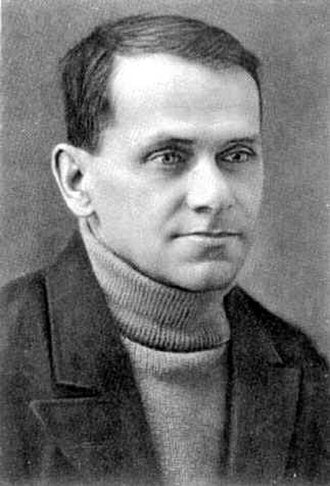
Pavel Blonsky
1884–1941 · Soviet psychologist, philosopher and educator
Pavel Blonsky (Pavel Petrovich Blonsky, 1884-1941) was a Russian and Soviet psychologist, philosopher and educator, and the founder of Soviet paedology. He matters because he tried to build a science of childhood in the service of socialism, and his story shows how psychology and education were shaped by politics in the early Soviet Union.
Born in 1884 in Kyiv, then part of the Russian Empire, to a local government official, he studied at a classical gymnasium and then at Kyiv University, graduating in history and philosophy. He was drawn early to socialism, particularly the Bolsheviks, and was imprisoned more than once. In 1913 he became a privatdocent at Moscow University. There he began to argue that schooling should transmit socialist values and prepare pupils for industrial and factory work.
After the October Revolution he became a professor at Moscow University and the first head of the Academy of Socialist Education. In the years 1918 to 1930 he produced more than a hundred works supporting the new educational system. He was among the main theorists of paedology and brought behaviourism into Russian psychology under the name "objective Marxist psychology". In 1936 he was sharply criticised for defending psychological testing and the study of innate differences between individuals, ideas that clashed with official doctrine, and his work was disowned. He died of tuberculosis in 1941.
Key ideas
- Education as social tool: schooling should form workers and citizens who share socialist ideals.
- Paedology: the scientific study of the child, combining psychology, pedagogy and physiology, as the basis of education.
- Objective Marxist psychology: observable behaviour, rather than introspection, as the object of psychology, in dialogue with behaviourism.
- Memory and thinking: the study of recollection and the development of children's thought as processes shaped by social conditions.
Original Filopedia text based on Wikipedia (en) and Wikidata.