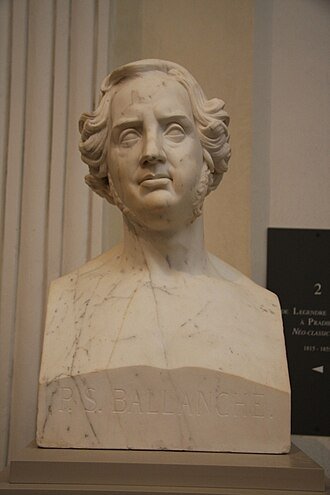
Pierre-Simon Ballanche
1776–1847 · French counterrevolutionary writer and philosopher
Pierre-Simon Ballanche (Lyon, 1776 – 1847) was a French writer and counterrevolutionary thinker whose theology of progress carried considerable weight in literary circles at the start of the nineteenth century. To understand him, one has to keep in mind both the Revolution that shaped his youth and the Christian tradition he hoped to renew.
The Revolution marked him early. In 1793 Lyon's royalist revolt against the Convention ended with the execution of about 700 people, and that experience, together with an unhappy early love affair, left him with a tragic sense of life as suffering that could still mean something. He worked for some years as a printer, and in 1802 he published Du sentiment considéré dans son rapport avec la littérature, written in the vein of Chateaubriand's Génie du christianisme. Later he met Julie Récamier and became a regular at her salon in Paris.
His major project, never completed, was Essais de palingénésie sociale. He pictured history as a series of regenerations in which humanity passes through a fall from an original perfection, a period of trial, and a final return to perfection. For Ballanche, language was a direct gift from God and the origin of society was tied to it, which led him to a poetics of the symbol that helped shape early Romanticism. He argued that the Revolution had a providential meaning and that some forms of authority could fall without becoming contemptible. His legacy sits uneasily between progressive and counterrevolutionary camps, and he never managed the reconciliation he hoped to achieve.
Key ideas
- Progress through ordeals: history advances through fall, expiation and regeneration, a scheme close to the Christian story of Fall and Redemption.
- The legitimacy of what has fallen: a political authority can lose its right to continue without becoming contemptible.
- Language and creation: to name something is to take part in creation, and poetic speech shares the essence of revelation.
- Palingenesis: society is regenerated in successive stages, the central idea of his unfinished work.
Curiosities
A self-comparison with Janus
Ballanche compared himself to Janus, the two-faced god of mythology, because he looked in two directions at once.
A member of the Académie française
He was elected to the Académie française in 1842, occupying seat 4.
Original Filopedia text based on Wikipedia (es) and Wikipedia (en) and Wikidata.