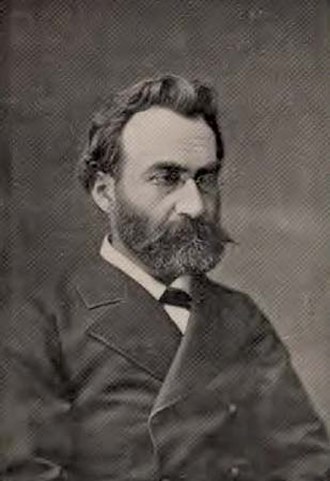
Raffi
1835–1888 · Armenian novelist and journalist
Hagop Melik Hagopian, known by the pen name Raffi, was one of the leading Armenian novelists of the nineteenth century. Born in 1835 in the Salmas region of northwestern Iran, he wrote in Armenian, and his work, especially his historical novels, helped shape modern Armenian national consciousness. He is still regarded as one of the most influential and widely read Armenian authors.
He came from a family of melik, the local Armenian minor gentry, and his father was a merchant. After studying in Tiflis he had to leave his schooling because of family money troubles and return home to help run the business. In the years that followed he travelled through the Armenian-populated provinces of Iran and the Ottoman Empire, gathering information on village life, the region's geography and the population's historical memory. Those journeys later provided material for his fiction.
His first poems appeared in 1853, and from 1860 he began publishing in the Armenian press. After settling in Tiflis around 1868, he was forced to take over the family firm, which went bankrupt, and he lived with near-constant financial pressure. Things improved somewhat when he joined the newspaper Mshak, where his novels were serialized and he became its most popular contributor. He also taught at Armenian schools in Tabriz and Agulis, but left the post after conservative opposition to his novel Harem, which criticized traditional eastern society.
His style pairs a carefully crafted language with direct, accessible prose. He held a romantic nationalist outlook that placed patriotism and the unity of Armenians in Iran, Russia and the Ottoman Empire above religious divisions. He believed education was the main route to progress and sharply criticized a clergy he saw as obscurantist. He died in Tiflis in 1888, and thousands attended his funeral.
His legacy is broad. Many regard him as the ideological forerunner of Armenian revolutionary movements, although he favoured self-defence over armed uprising. Readers from across the political spectrum claimed him, and in Soviet Armenia he was honoured again in the 1950s. Schools and streets in several Armenian towns still bear his name.
Key works
- Samuel (1886-1887, published in book form in 1888): a historical novel about Armenian resistance.
- Harem (1874): a critique of traditional eastern society and the position of women.
- The Fool (Khent'ë, 1880-1881): a novel about a character who dreams of a united, independent Armenia.
- Davit Bek (1880-1882): a historical novel about Armenian resistance to foreign domination.
- The Golden Rooster (Voski ak'aghagh, 1879-1882): a patriotic tale reflecting on the nation's fate.
Curiosities
A reader turned militant
According to one account, the typist who copied his novel The Fool went on to join a partisan group in Ottoman Armenia as soon as he finished the job. This anecdote comes from secondary sources and is unverified.
A pen name from Arabic
He began signing his work as Raffi during his years writing for Mshak. The name derives from an Arabic form.
Teachers and influences
Influenced by
- Khachatur Abovian 1809–1848
Original Filopedia text based on Wikipedia (es) and Wikipedia (en) and Wikidata.