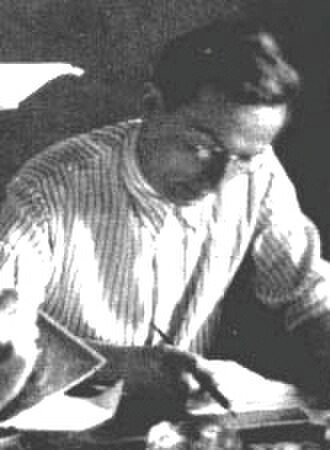
Rudolf Arnheim
1904–2007 · German-born psychologist and art theorist
Rudolf Arnheim (Berlin, 1904 - Ann Arbor, Michigan, 2007) was a perceptual psychologist and writer on art and film, born in Germany and trained in Gestalt psychology. His work remains a key reference for anyone who wants to understand how we see images and why seeing can be a form of thinking rather than a passive recording of data.
He studied at the University of Berlin, where he worked with Max Wertheimer and Wolfgang Köhler, and earned his doctorate in 1928 with research on facial expression and handwriting. In the mid-1920s he was already writing film criticism and cultural essays for Berlin magazines. After the Nazis came to power he left Germany in 1933 and lived in Rome and London before settling in the United States, where he taught at Sarah Lawrence College and later at Harvard and the University of Michigan.
His best-known book, Art and Visual Perception (1954), applies the science of perception to the understanding of art. For Arnheim, perception is not a matter of registering stimuli: the viewer organizes them into shapes and completes them with past experience, so looking is already a kind of reasoning. In Visual Thinking (1969) he challenged the idea that language always comes before perception, arguing that some qualities and feelings escape words. Later, in The Power of the Center (1982), he examined how compositions built around centers or grids reveal patterns of human experience.
His influence reaches the history of art, the psychology of perception, film theory, and the study of design and architecture. His work is still read as an attempt to bridge science and aesthetic experience.
Key ideas
- Perception as reasoning: seeing is not passively receiving data but organizing it into meaningful forms.
- Direct and indirect perception: what we see is completed by mental images built from past experience.
- Limits of language: words name what has already been perceived and can make it harder to grasp qualities that only vision reaches.
- Decontextualization: the mind tends to isolate objects from their context, while the artist recovers a way of looking that attends to relationships.
- Inseparable form and content: in art, composition reveals the nature of human experience.
Original Filopedia text based on Wikipedia (es) and Wikipedia (en) and Wikidata.