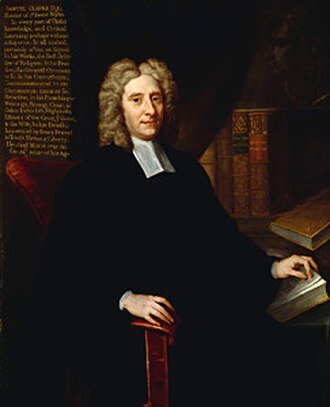
Samuel Clarke
1675–1729 · English philosopher and Anglican priest, a major British figure between Locke and Berkeley
Samuel Clarke (11 October 1675 - 17 May 1729) was an English philosopher and Anglican priest, considered the most important British figure in philosophy between John Locke and George Berkeley. His work combined a defence of Isaac Newton's physics with a rational theology aimed at proving the existence of God.
He was the son of an alderman of Norwich who also sat in Parliament. Clarke studied at Norwich School and at Gonville and Caius College, Cambridge, where Cartesian physics still prevailed. There he came to admire Newton. Before he was twenty-two he had published an annotated Latin version of Jacques Rohault's physics textbook, using it to argue for Newton's system over the Cartesian one.
After taking holy orders he worked in London and became a chaplain to Queen Anne. In 1704 and 1705 he delivered the Boyle Lectures, later published as a book, which argued that the existence of a necessary, eternal and infinite being could be demonstrated from the order and purpose of the world. Clarke held that the essence of this being is beyond our comprehension, while its essential attributes can be demonstrated, and he treated time and space as attributes of God rather than independent substances. The argument sparked a British debate that lasted into the middle of the century.
Clarke also wrote on the mind. In 1707 and 1708 he corresponded publicly with the freethinker Anthony Collins about consciousness. Against the view that thought is an emergent property of the brain, Clarke insisted that mind and matter must be distinct. In 1712 he published The Scripture Doctrine of the Trinity, whose subordinationist views drew criticism within the Church of England and led him to swear to the Thirty-Nine Articles. From 1715 to 1716 he also corresponded with Leibniz on natural philosophy and religion, an exchange cut short by Leibniz's death.
His influence can be seen in English rational theology and in debates over the proofs of God's existence. His nontrinitarian revision of the 1662 Book of Common Prayer still shapes the worship of modern Unitarians.
Key ideas
- A posteriori argument: the existence of a necessary, eternal being can be shown from the order, purpose and perfections of the world.
- Incomprehensible essence: although God's essence is beyond us, his essential attributes such as infinity, wisdom and goodness can be demonstrated by reason.
- Time and space as attributes: time and space are not independent substances but attributes of the necessary being.
- Mind distinct from matter: thought and consciousness cannot be explained as a property that emerges from matter.
Curiosities
An annotated textbook
Before turning twenty-two he published a Latin version of Jacques Rohault's physics treatise with commentary favouring Newton's physics.
An interrupted correspondence
His exchange of letters with Leibniz in 1715 and 1716 ended abruptly with the German philosopher's death.
An oath after his doctorate
After his formal disputation for the doctorate in divinity in 1710, he was required to swear to the Thirty-Nine Articles of the Church of England.
Original Filopedia text based on Wikipedia (es) and Wikipedia (en) and Wikidata.