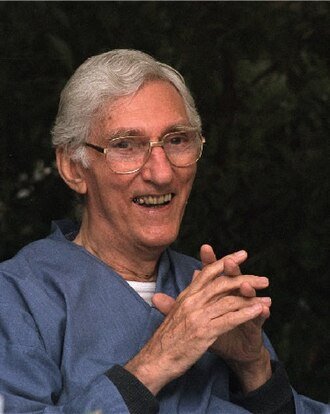
Sangharakshita
1925–2018 · British Buddhist monk, founder of the Triratna Buddhist Community
Sangharakshita (born Dennis Philip Edward Lingwood, London, 1925 – Hereford, 2018) was a British Buddhist monk and writer who founded the Friends of the Western Buddhist Order in 1967, later renamed the Triratna Buddhist Community. His legacy is contested: supporters see him as a pioneer who brought Eastern teachings to the West, while critics accuse him of sexually exploiting young men who trusted him as their teacher.
As a child, a heart condition kept him in bed for long periods, and he read widely. After serving as a radio engineer in India, Ceylon and Singapore during the Second World War, he left the army in India and became a novice monk in 1949. He spent fourteen years in Kalimpong, where he founded an ecumenical centre and met the German-born lama Govinda, who introduced him to Tibetan Buddhism. In 1952 he came to know B. R. Ambedkar, the leader of the Untouchables who converted to Buddhism.
He returned to England in 1966, and in 1967 founded what would become the Western Buddhist Order. He aimed to create a form of Buddhism that was neither lay nor monastic, with members taking ten precepts from the Mahayana tradition. In 2000 he handed leadership to a college of eight preceptors. He died in 2018, aged 93.
Key ideas
- Ecumenical Buddhism: he rejected sectarian boundaries and sought the essential teachings of all major schools.
- Neither lay nor monastic: he proposed an order whose members were neither laypeople nor monks in the usual sense.
- Engaged Buddhism: he championed a critically engaged Buddhism, inspired by his work with Ambedkar and the dalit communities.
- Against formalism: he saw dogmatism and nationalism in some traditions as obstacles to the Dharma.
Curiosities
Discovering Buddhism
According to his account, after reading Blavatsky's Isis Unveiled he realised he had never been a Christian. The following year he found Buddhist texts and concluded he had always been a Buddhist.
Declining a ceremony
Ambedkar first invited him to lead his conversion ceremony, but he declined and suggested that the monk U Chandramani preside.
Original Filopedia text based on Wikipedia (es) and Wikipedia (en) and Wikidata.