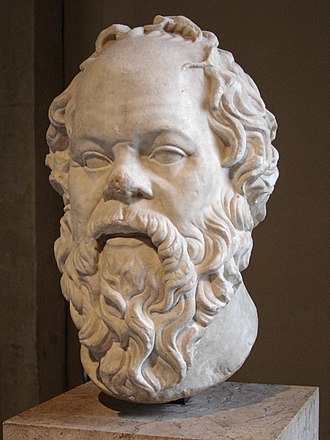
Socrates
469 BC–398 BC · ancient Greek philosopher of Classical Athens, founder of moral philosophy
Socrates (469-399 BC) was an ancient Greek philosopher born in Athens, regarded as one of the central figures of Western thought. His significance is twofold. He redirected philosophy away from the study of nature and toward human beings, virtue and life in the city. He was also the teacher of Plato, and through Plato his influence reaches much of the later tradition. He lived in the period of Athens' greatest brilliance, in the fifth century BC, and is usually placed at the transition between the pre-Socratic thinkers and classical philosophy.
He was the son of Sophroniscus, a stonemason, and of Phaenarete, a midwife. He received the education typical of a young Athenian: literature, music and gymnastics, and later exposure to the dialectic and rhetoric practised by the sophists. According to tradition he worked for a time in his father's trade, though the claim that he made statues of the Graces is uncertain. He married Xanthippe, whom ancient sources often describe as a difficult wife, although Plato's Phaedo presents a more amiable relationship. He served as a hoplite in several campaigns of the Peloponnesian War, where he was noted for his courage, and took part in public life as a member of the assembly, though he avoided party politics. He is remembered for refusing to put an unconstitutional motion to a vote during the trial of the generals after Arginusae.
His appearance was striking: short, with a protruding belly and bulging eyes, and his manner of dress and living was austere. He moved through the squares and gymnasiums of Athens conversing with anyone, above all with young men from wealthy families, whom he questioned about what they believed they knew. His method was to examine moral concepts such as the good, justice and virtue through successive questions until his interlocutor discovered his own contradictions. He often claimed to know only that he knew nothing, an irony that irritated some and fascinated others. This practice is what is now called the Socratic method, or elenchus.
Socrates left no writings. We know him mainly through the dialogues of Plato, and to a lesser extent through those of Xenophon and the comedies of Aristophanes, who caricatured him. These sources do not fully agree, and separating the historical Socrates from the Platonic character remains a problem for scholars. His central ideas hold that virtue is a form of knowledge, that no one does wrong knowingly, and that care for the soul matters more than wealth.
In 399 BC he was accused of impiety and of corrupting the young. A jury found him guilty, and although his friends offered to help him escape, he chose to accept the sentence and drank hemlock. His death made him a symbol of philosophy devoted to truth. After him arose the minor Socratic schools, such as the Cynics and the Cyrenaics, alongside Plato's Academy. His influence reached Hellenistic philosophy, medieval and Islamic scholars, Renaissance humanism and modern thinkers such as Kierkegaard and Nietzsche, and he remains a model of critical thought in art and popular culture.
Key ideas
- Virtue as knowledge: doing well depends on knowing what the good is, and no one does wrong knowingly.
- Dialectical method: examining ideas through questions and answers, which exposes the contradictions in accepted opinions.
- Socratic ignorance: recognising what one does not know is the starting point of the search for truth.
- Care of the soul: concern for one's own virtue and justice matters more than wealth, fame or power.
- Obedience to the law: even an unjust sentence should be accepted rather than breaking the order of the city.
Curiosities
His trial and death
He was condemned by an Athenian jury in 399 BC and, according to Plato, refused the chance to escape from prison. He drank hemlock, a poison commonly used to carry out death sentences.
A rooster for Asclepius
According to the account in the Phaedo, his last words asked Crito to sacrifice a rooster to Asclepius, the god of medicine.
Teachers and influences
Pupils
- Plato 428 BC–348 BC
- Xenophon 430 BC–353 BC
- Antisthenes 444 BC–364 BC
- Aristippus 434 BC–365 BC
- Euclid of Megara 450 BC–364 BC
Influenced by
- Anaxagoras 499 BC–427 BC
Influenced
- Aristotle 383 BC–321 BC
- Plato 428 BC–348 BC
- Friedrich Nietzsche 1844–1900
- Aristophanes 444 BC–384 BC
- Karl Popper 1902–1994
- Hannah Arendt 1906–1975
- Zeno of Citium 333 BC–262 BC
- Antisthenes 444 BC–364 BC
- Aristippus 434 BC–365 BC
- Euclid of Megara 450 BC–364 BC
Original Filopedia text based on Wikipedia (es) and Wikipedia (en) and Wikidata.