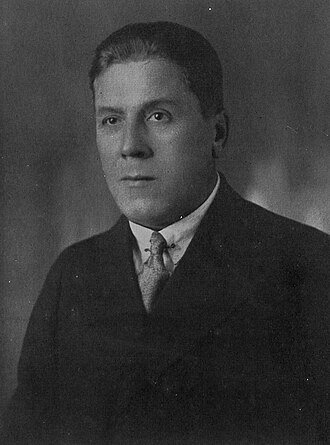
Stanisław Leśniewski
1886–1939 · Polish logician, mathematician and philosopher
Stanisław Leśniewski (1886-1939) was a Polish logician, mathematician and philosopher, and a leading figure of the Lwów–Warsaw School. He is best known for devising mereology, a formal theory of parts and wholes, and for a set of nested formal systems meant to give logic and mathematics a rigorous foundation.
He was born at Serpukhov, near Moscow, into a family that moved often because of his father's work as a railway engineer in the Russian Empire, and he finished secondary school in Irkutsk. Between 1909 and 1910 he attended lectures by Hans Cornelius in Munich and later heard Wacław Sierpiński in Lwów. His 1912 doctoral thesis partly challenged Brentano's view that every categorical proposition can be reduced to an existential one. In 1919 he became professor of the philosophy of mathematics at the University of Warsaw. During the Polish–Soviet War he helped break Soviet ciphers for the Polish General Staff.
His main achievement was the construction of three nested formal systems: protothetic, ontology (sometimes called the calculus of names) and mereology (the calculus of individuals). A radical nominalist, he rejected axiomatic set theory and proposed his collective classes as an alternative, since they could not be reduced to their constituent elements. His writings, marked by an enigmatic style and an idiosyncratic notation, circulated little directly; much of what we know of his thought comes from his students' notes. Although Alfred Tarski was his only doctoral student, he shaped an entire generation of Polish logicians. He died in 1939, shortly before the German invasion, and most of his remaining papers were destroyed.
Key ideas
- Mereology: a formal theory of the relations between parts and wholes, presented by Leśniewski as an alternative to set theory.
- Protothetic: the calculus of propositions, the most basic level of his nested systems.
- Ontology: the calculus of names, dealing with relations among nominal expressions in an unambiguous formal language.
- Radical nominalism: rejection of axiomatic set theory, which he saw as prone to paradoxes such as Russell's.
- Categorial grammars: precise systems for interpreting natural language and reducing its ambiguities.
Curiosities
Codebreaker in the war
During the Polish–Soviet War of 1919–1921 he helped break Soviet ciphers for the Polish General Staff.
Teachers and influences
Influenced by
- Kazimierz Twardowski 1866–1938
Original Filopedia text based on Wikipedia (es) and Wikipedia (en) and Wikidata.