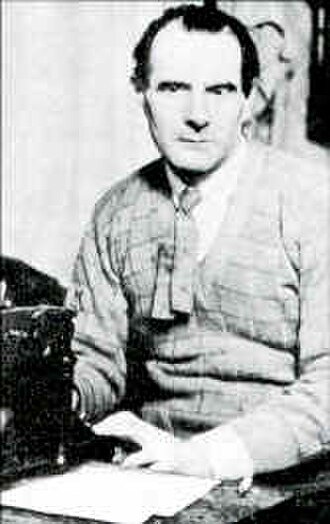
 AuthorSeán O'Casey1880–1964
The Plough and the Stars is a four-act play by the Irish playwright Seán O'Casey, first performed on 8 February 1926 at the Abbey Theatre in Dublin. Set in the Irish capital, it deals with the Easter Rising of 1916, the armed uprising against British rule that marked the beginning of the process that would lead to Irish independence. Its title refers to the Starry Plough flag used by the Irish Citizen Army, the workers' militia founded by James Connolly.
It is the third play of O'Casey's so-called Dublin Trilogy, alongside The Shadow of a Gunman (1923) and Juno and the Paycock (1924). Whereas the earlier two plays dealt with the War of Independence, this one focuses more directly on the rising and on the clash between patriotic ideals and everyday life in the working-class tenements. The first two acts take place in November 1915, when the residents of a tenement house speak eagerly of Ireland's future liberation; the last two are set during Easter 1916.
The central figure is Jack Clitheroe, a bricklayer and former member of the Citizen Army, whose wife Nora watches him drawn into nationalist rhetoric and the vanity of military promotion. Around them moves a chorus of neighbours, among them a charwoman, a socialist carpenter, a young communist, a Protestant fruit-seller and a prostitute, who together reflect the social and religious diversity of the city. Through this gallery, O'Casey sets the heroic language of the movement against the hardships, humour and small miseries of ordinary people.
The play provoked considerable controversy. Before its premiere, the Abbey's directors asked O'Casey to soften some of the blasphemy and to remove a song sung by the prostitute Rosie Redmond. During the early performances, parts of the audience, including members of republican organisations, protested loudly at what they saw as an irreverent portrayal of the rising; the disturbances continued over several performances and revived debate about artistic freedom in the face of political and social pressure.
Over time, The Plough and the Stars has become one of the most important works of twentieth-century Irish theatre. Its value lies in showing the human side of the national epic without abandoning its tragic dimension, and in questioning the heroic myth from within the independence movement itself.
Themes
Other works by Seán O'Casey
Original Filopedia text based on Wikipedia (en) and Wikidata.