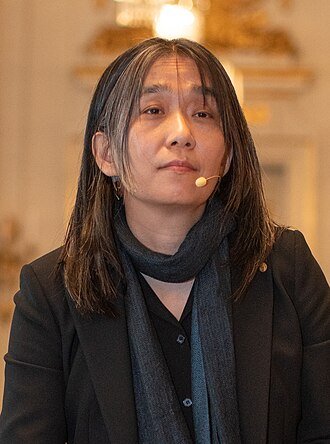
 AuthorHan Kangb. 1970
We Do Not Part is a 2021 novel by South Korean writer Han Kang, published by Munhak. Although its plot unfolds in the present, the book revolves around the Jeju massacre, one of the gravest and most silenced episodes in South Korea's recent history, and the way the past continues to weigh on those who inherit it. The author regards this work as a companion to her earlier novel, Human Acts, which dealt with the repression in Gwangju.
The protagonist, Kyungha, is a writer working on a new novel far from her family. She suffers from insomnia and recurring nightmares in which snow-covered trees take human shape. These visions began while she was writing her previous book, about state violence against civilians. One day she receives a message from her old friend Inseon, whom she knew from their years as freelance videographers, asking her to visit the hospital: Inseon has cut off her fingers at the carpentry workshop she runs on Jeju Island, where she moved to care for her mother, who has dementia. Inseon also begs Kyungha to look after her bird, Ama, which may die of thirst and hunger. Kyungha travels to the island through a blizzard, and along the way she recalls the time she spent with her friend and a confession about the destruction of a village. On arrival, the night, the snow and a power outage plunge her into hallucination, where the line between reality and imagination dissolves. Inseon appears in the house and shows her archival material on the massacre, which reveals the fate of her uncle, who was captured, imprisoned and killed. The novel ends with Inseon's disappearance and with Kyungha uncertain whether everything she has lived was real or the product of her dying.
The book is anchored in the Jeju massacre, which took place between 1948 and 1949, after Korea's liberation and during the early years of the Republic of Korea. The island endured protests, uprisings and a military crackdown that, by estimates, killed tens of thousands. Han Kang sets her story decades later, so that the horror appears as memory, inheritance and mourning. The seven years she spent on the novel, which she described as both an arduous task and her happiest moment upon finishing it, produced one of her most acclaimed works.
Its international reception has been considerable. In 2023 it won the Prix Médicis for Foreign Literature, making Han the first Korean author to receive the prize, and it was shortlisted for the Prix Femina. In 2024 it also earned the Émile Guimet Prize for Asian Literature. Korean critics praised the force with which the novel presents the massacre as a tragedy still demanding attention, and its use of snow as an image joining past and present.
Themes
Other works by Han Kang
- The Vegetarian 2007
- Greek Lessons 2011
- Human Acts 2014
- The White Book 2016
Original Filopedia text based on Wikipedia (es) and Wikipedia (en) and Wikidata.