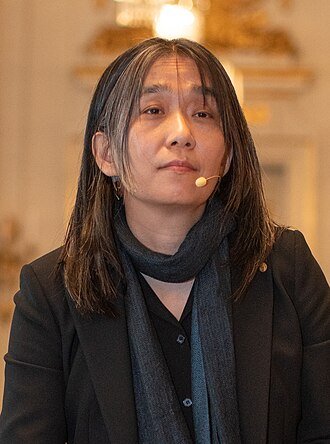
 AuthorHan Kangb. 1970
The Vegetarian is a 2007 novel by the South Korean writer Han Kang. Set in present-day Seoul and divided into three parts, each narrated from a different perspective, it centres on Yeong-hye, an ordinary woman who, after a disturbing dream about human cruelty, decides to stop eating meat and, later, all animal products. That apparently small choice sets off a chain of consequences that reaches her marriage, her family and her own mental health.
The first part, "The Vegetarian", is narrated in the first person by her husband, Mr. Cheong. He regards his wife as unremarkable and married her expecting a dutiful partner who would fit the conventional life he wanted. When Yeong-hye begins to refuse meat and grows thinner, her family tries to make her eat at a tense dinner that ends with a wound on her wrist and her admission to hospital. The second part, "Mongolian Mark", follows her brother-in-law, a video artist who becomes fixated on her and on a birthmark shaped like a petal, and turns her into the subject of an artistic project that crosses the boundaries of intimacy and ethics. The third, "Flaming Trees", follows her sister In-hye, who tries to hold on to Yeong-hye as she moves further from human behaviour and towards a vegetal state.
The novel grew out of an earlier short story by the author, "The Fruit of My Woman" (1997), in which a woman literally turns into a plant. Han Kang reworked that image in a darker form. She has said that the idea was partly sparked by her reading of Yi Sang and his line "I believe that humans should be plants", and the book reflects her long-standing concern with violence and with the impossibility of innocence. The three parts were first published as separate novellas, and the work was received with some bewilderment in South Korea, although "Mongolian Mark" won the Yi Sang Literary Prize.
The book deals with desire, shame and empathy, shown in the hesitant efforts of its characters to understand the people around them. Deborah Smith's English translation, published in 2015, brought it to a wide international readership, and in 2016 it won the Man Booker International Prize. It has since become one of the best-known works of contemporary Korean literature and has been translated into many languages.
Themes
Other works by Han Kang
- Greek Lessons 2011
- Human Acts 2014
- The White Book 2016
- We Do Not Part 2021
Original Filopedia text based on Wikipedia (es) and Wikipedia (en) and Wikidata.