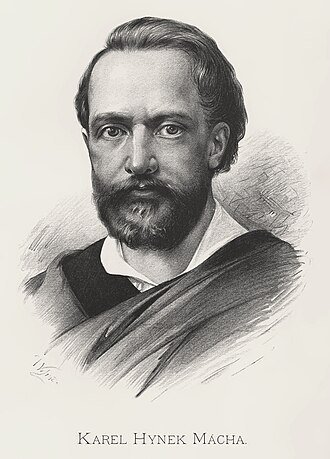
 AuthorKarel Hynek Mácha1810–1836
Máj is a lyric-epic poem by Karel Hynek Mácha, published in 1836, and is considered one of the high points of Czech Romanticism. Its title is the Czech word for the month of May. Mácha set aside the nationalist program of the Czech National Revival that dominated the first half of the nineteenth century and treated the work as the confession of a desolate Romantic self, restless with questions about the meaning of life and about death.
The story is loosely based on a real event. In 1774, near Mladá Boleslav, a man named Hynek Schiffner was broken on the wheel after killing his father in the village of Dubá. Mácha heard the tale some six decades later during his stays in the region, today associated with the lake that now bears his name. The manuscript surfaced during the First World War among the papers of Jan Nepomuk Krouský, in Katusice.
The plot follows Vilém, a feared bandit chief who unknowingly kills his rival in love, who turns out to be his own father, the man who had cast him out of the house as a child. Condemned to death, Vilém spends his final hours in prison reflecting on his fate, remembering his beloved Jarmila, and refusing to accept guilt, which he sees as the legacy of a selfish father. The jailer, moved by his account, falls silent for the rest of his life. After long monologues in which death appears as the definitive end, the prisoner is led to the scaffold through a crowd of people praying, and takes leave of his beloved land in tears. The work frames this story with an opening scene in which Jarmila waits in vain for Vilém, and a closing scene in which a traveler, a stand-in for the author, contemplates the skeleton on the wheel and identifies with the executed man.
The poem has four cantos and two intermezzos, preceded by a dedication. Its main meter is the iamb, unusual in Czech poetry of the period, and it is rich in metaphors, oxymorons, epithets and contrasts between light and darkness, life and death. Mácha claimed in a prefatory note that the poem's purpose was to praise spring, a remark many readers take as a tactic to deflect the censors. Its early reception was cool and even hostile, with criticism from contemporaries such as Josef Kajetán Tyl and František Palacký. Over time, Máj became required reading in the Czech Republic and one of the most frequently published Czech books.
Themes
Original Filopedia text based on Wikipedia (es) and Wikipedia (en) and Wikidata.