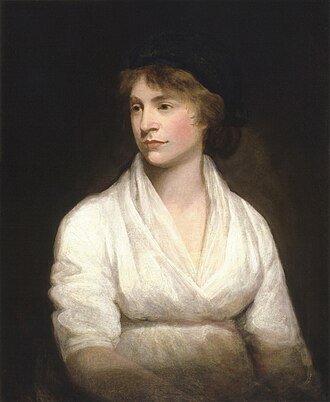
 AuthorMary Wollstonecraft1759–1797
A Vindication of the Rights of Woman is an essay published in 1792 by the British writer Mary Wollstonecraft, regarded as one of the pioneering works of feminist literature and philosophy. Its full title is A Vindication of the Rights of Woman: with Strictures on Political and Moral Subjects. Wollstonecraft wrote it amid great turbulence: the French Revolution and the debates it had sparked in Britain, in a lively pamphlet war that ranged from representative government to human rights and the separation of church and state.
The book grew out of her earlier A Vindication of the Rights of Men (1790), a reply to Edmund Burke's Reflections on the Revolution in France. Where that work concerned a particular group of British men, this one widens the argument to women as a general category. Wollstonecraft holds that natural rights are granted by God, so denying them to one part of society is a sin, and that rights must rest on reason and justice rather than on tradition.
The immediate trigger was a 1791 report by Charles Maurice de Talleyrand-Périgord to the French National Assembly, which proposed that women receive only a domestic education. Wollstonecraft dedicated the book to him, inviting him to reconsider. From that starting point she denounces double standards and accuses men of encouraging excessive emotion in women, which keeps them dependent. Rather than seeing women as ornaments of society or as property traded in marriage, she insists that they are human beings entitled to the same fundamental rights as men.
The core of the argument is rational education. Wollstonecraft contends that women are capable of reasoned thought and should be educated to become companions to their husbands rather than mere wives, and to raise children capably. She wrote quickly, in direct response to unfolding events, and intended a more considered second volume that she never completed before her death in 1797.
The essay is long and blends rational argument with the impassioned rhetoric of sensibility, a fashion of the period. Wollstonecraft's chief demands for equality concern morality and education, and her ambiguity about full equality, including political rights, makes it difficult to classify her neatly as a modern feminist, a term that did not yet exist.
The idea that the book was poorly received is a later misconception. It was generally well received on publication; the hostility came afterwards, when the Memoirs written by her husband William Godwin in 1798 exposed details of her private life. Over time the book became an important reference for nineteenth-century advocates of women's rights, notably the Declaration of Sentiments produced at the Seneca Falls Convention of 1848.
Themes
Books to read
- A Vindication of the Rights of Woman With Strictures on Political and Moral Subjects EnglishEPUB 271 KBRead online
Other works by Mary Wollstonecraft
Original Filopedia text based on Wikipedia (es) and Wikipedia (en) and Wikidata.