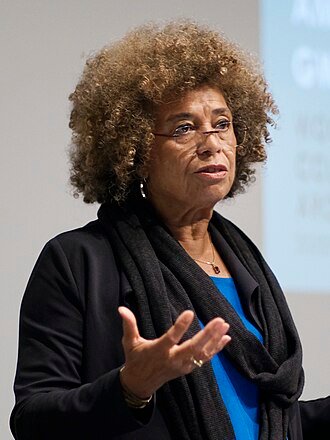
Angela Davis
b. 1944 · American Marxist feminist philosopher and activist
Angela Davis (born in Birmingham, Alabama, in 1944) is an American philosopher, academic and activist whose work combines Marxism, feminism and anti-racism. She is best known for her political campaigns from the 1970s onward, but her thinking has a lasting place of its own. Her book Women, Race and Class (1981) became a central text in Black feminist and intersectional thought written from a Marxist perspective, and it remains widely read today.
She grew up in a family of civil rights activists in a city shaped by the segregation of the Jim Crow laws. Her family's neighbourhood was nicknamed Dynamite Hill because the Ku Klux Klan bombed many homes owned by Black families there, an experience that shaped her early awareness of racial violence. With a scholarship from a Quaker organisation she moved to New York, where she encountered socialist ideas and joined a Marxist youth group. She studied French at Brandeis University, where she first heard Herbert Marcuse speak, and later studied philosophy in Frankfurt, mixing with the German student left. She followed Marcuse to the University of California, San Diego, where she earned a master's degree but never completed her doctorate.
Her membership in the Communist Party USA cost her a post as a philosophy lecturer at UCLA in 1969, when the university dismissed her after her affiliation became known. Soon afterwards she was caught up in a case linked to a courtroom shootout in Marin County, in which guns registered in her name had been used. After more than a year in jail she was acquitted of all charges, and her case drew worldwide attention and support from activists and artists. She later joined the party's central committee and, in 1984, ran for vice president alongside Gus Hall.
In 1991 she broke with the party and helped found the Committees of Correspondence for Democracy and Socialism. That same year she joined the University of California, Santa Cruz, where she led its feminist studies department until retiring in 2008. In 1997 she co-founded Critical Resistance, which seeks to abolish the prison-industrial complex, a subject on which she has written two books. Her influence reaches intersectional feminism, penal critique and contemporary activism, and in 2020 Time magazine named her among the one hundred most influential people in the world.
Key ideas
- Black feminism and Marxism: gender, race and class are interwoven forms of oppression that cannot be analysed separately.
- Critique of the prison system: prisons work as instruments of social control, and their abolition is framed as a political goal rather than only a matter of reform.
- Theory joined to action: critical thought must become commitment, an idea she took from Herbert Marcuse, who held that individuals have a duty to rebel against an unjust system.
Curiosities
Dynamite Hill
Her family's neighbourhood was nicknamed Dynamite Hill after many homes of Black families there were bombed by the Ku Klux Klan.
A Time honour
In 2020 Time magazine included her on its list of the one hundred most influential people in the world.
Teachers and influences
Teachers
- Herbert Marcuse 1898–1979
Original Filopedia text based on Wikipedia (es) and Wikipedia (en) and Wikidata.