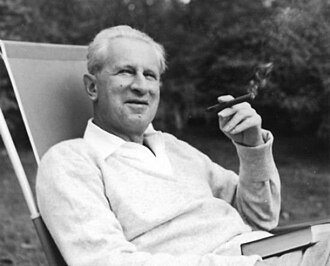
Herbert Marcuse
1898–1979 · German-American philosopher and social critic of the Frankfurt School
Herbert Marcuse (Berlin, 1898 – Starnberg, 1979) was a German-American philosopher and social critic of Jewish background, a leading figure of the first generation of the Frankfurt School. Combining Marxism with Freudian psychoanalysis and cultural criticism, his work became one of the most influential voices of twentieth-century critical thought.
He came from a well-established upper-middle-class Jewish family in Berlin. He studied in Berlin and Freiburg, where he earned his doctorate in 1922 with a thesis on the German Künstlerroman. After the First World War he joined the Social Democratic Party, but left it in 1919 after the murders of Rosa Luxemburg and Karl Liebknecht, which he saw as a sign of the party's complicity. At Freiburg he prepared a habilitation under Martin Heidegger, published in 1932 as Hegel's Ontology and the Theory of Historicity. The relationship ended when Heidegger moved toward National Socialism, which Marcuse regarded as a betrayal of philosophy.
After Hitler came to power he joined the Institute for Social Research, which had moved its funds to Holland, and began working in Geneva. He emigrated to the United States in 1934 and worked at the institute's branch at Columbia University. During the war he worked for the Office of War Information and the Research and Analysis Branch of the OSS, where he analyzed Nazism. After 1945 he joined the State Department, and later taught at Harvard, Brandeis and the University of California, San Diego.
In Reason and Revolution (1940) he reread Hegel and Marx dialectically. In Eros and Civilization (1955) he argued that industrial society imposes a surplus repression beyond what civilization requires, and he looked to the erotic nature of human beings as a path to liberation. In One-Dimensional Man (1964) he described a society that absorbs its citizens through consumption and technology until the capacity to imagine alternatives fades. In his essay Repressive Tolerance (1965) he held that indiscriminate tolerance tends to benefit the powerful.
In the 1960s and 1970s he came to be seen as a key figure of the New Left and the student movements, although he downplayed the title of father of that movement. His analyses remain present in debates about technology, consumption, tolerance and mass culture.
Key ideas
- One-dimensional society. Advanced industrial society absorbs individuals through consumption and technology, weakening the force of critical thought.
- Surplus repression. Beyond the repression civilization requires, industrial society imposes an additional repression on human instincts.
- Marx and Freud together. Human liberation requires attention both to material conditions and to the erotic nature of human beings.
- Repressive tolerance. A tolerance that fails to distinguish oppressors from the oppressed ends up sustaining the status quo.
Where to start
One-Dimensional Man 1964
The One-Dimensional Man is an accessible critique of advanced industrial society, where consumption, technology and administration shape thought until it becomes conformist. It offers a clear diagnosis of why freedom seems to exist without being fully realized, making it the most direct entry point into Marcuse's thought.
Next: Eros and Civilization. Eros and Civilization, from 1955, revisits Freud to show how sexual repression and civilization are linked, helping readers grasp the deeper roots of the critique Marcuse develops afterward.
Works in Filopedia
Curiosities
Sniper hunting in Berlin
According to some accounts, during the postwar instability in Berlin he was assigned to search for right-wing snipers who were firing on left-wing demonstrators.
Grandfather, not father
The media called him the father of the New Left, but he replied that it would have been better to call him the grandfather, since the students of the 1960s did not wait for his books to act.
Teachers and influences
Pupils
- Angela Davis b. 1944
Influenced
- Jürgen Habermas 1929–2026
- Monique Wittig 1935–2003
- André Gorz 1923–2007
Original Filopedia text based on Wikipedia (es) and Wikipedia (en) and Wikidata.