Eros and Civilization
philosophical essay on social criticism and an interpretation of Freud · 1955
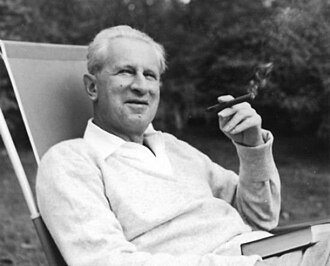 AuthorHerbert Marcuse1898–1979
Eros and Civilization: A Philosophical Inquiry into Freud is a book published in 1955 by the German philosopher and social critic Herbert Marcuse. Its title alludes to Sigmund Freud's Civilization and Its Discontents (1930), and the work grows out of an effort to take Freudian thought as a basis for reflecting on history and society. Marcuse attempts a synthesis of Marxist theory and psychoanalysis, doing so at a time when advanced industrial capitalism seemed to have solved much of material scarcity. A 1966 edition added a political preface by the author.
The central argument starts from Freud's claim that culture requires the permanent suppression of the instincts. Marcuse questions this idea and distinguishes between the repression that survival makes necessary and a "surplus repression", imposed by the forms of domination of human over human. He proposes that the reality principle is not a timeless condition of existence but a historically determined form that industrial society organizes around the logic of performance and competition. For this reason, as productivity grows, the possibility opens of reducing alienated labor and freeing Eros from its destructive limits. Marcuse maintains that art, born of fantasy, can anticipate a relationship with the world not governed by repression.
The book is organized into chapters that move from a description of the dominance of the reality principle to a reflection on what a society beyond it might be. Its reception was broad: it drew reviews in the United States and Britain and soon brought Marcuse international fame. Many commentators regard it as his most important work. It influenced the subcultures of the 1960s and the gay liberation movement, and it belongs to a debate that, alongside works such as Norman O. Brown's Life Against Death and Paul Ricoeur's Freud and Philosophy, placed Freud at the center of moral and philosophical inquiry. Some critics credited Marcuse with a convincing critique of neo-Freudianism; others accused him of utopianism and of misreading Freud, and doubted that the synthesis of Marxism and psychoanalysis was workable.
Themes
Other works by Herbert Marcuse
Original Filopedia text based on Wikipedia (es) and Wikipedia (en) and Wikidata.