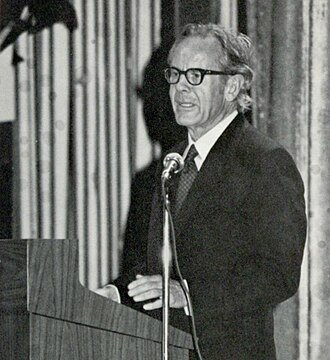
Rollo May
1909–1994 · American existential psychologist and psychotherapist
Rollo May (Ada, Ohio, 1909 – Tiburon, California, 1994) was an American psychologist and psychotherapist who became one of the leading figures of existential psychology and psychotherapy in the United States. He is often grouped with humanist psychologists, but he differed from figures such as Maslow or Rogers in his closer attention to the tragic dimensions of human existence. He was a close friend of the theologian Paul Tillich, whose ideas shaped much of his thinking.
His childhood was marked by his parents' divorce and by his older sister's mental illness, which left him carrying much of the family's burden. He studied at Michigan State and then at Oberlin College, where he took a degree in English. After teaching in Greece for a few years, he was ordained as a minister on his return to the United States, but later left the ministry to study psychology. His theological training at Union Theological Seminary grew partly out of a wish to understand anxiety, despair and suicide, subjects that psychology of the time largely ignored. He earned his doctorate in clinical psychology at Columbia University in 1949.
His first major book, The Meaning of Anxiety, grew out of his doctoral dissertation and drew on the work of Søren Kierkegaard. May argued that anxiety is not merely a symptom to be eliminated but an experience that, faced honestly, can support personal growth. In later works such as Psychology and the Human Dilemma and Love and Will, he extended this view to love, desire, violence and the meaning of existence. For May, love and will are closely linked, and love and sex are not the same thing. He sought to reconcile existentialism with Freudian psychoanalysis, and he regarded Otto Rank as the most important precursor of existential therapy.
His influence spread through American psychotherapy, where he helped to popularise existential thinking. His books, especially Love and Will, reached a wide readership beyond academic circles. He spent his last years in Tiburon, California, where he died in 1994.
Key ideas
- Anxiety: far from being only a symptom, it can become a force that, when faced well, drives personal growth.
- Love and will: love and will are distinct but related dimensions, and love is not reducible to sex.
- Stages of development: innocence, rebellion, the ordinary and the creative are ways of being in the world that people can move between over a lifetime, not rigid phases.
- Creativity as courage: the courage to create means facing anxiety and accepting one's destiny.
Curiosities
An inherited name
His name came from Rollo, the title character of a 19th-century series of children's books by Jacob Abbott, which May disliked; he later made peace with it after learning of Rollo the Conqueror, a tenth-century Norman.
A bestseller
In 1970 Love and Will won the Ralph Waldo Emerson Award for humane scholarship and became a bestseller.
Teachers and influences
Influenced by
- Otto Rank 1884–1939
- Kurt Goldstein 1878–1965
- Henri Ellenberger 1905–1993
Original Filopedia text based on Wikipedia (es) and Wikipedia (en) and Wikidata.