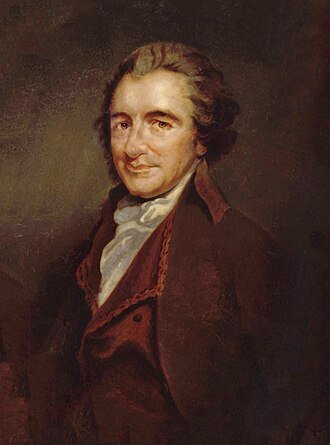
 AuthorThomas Paine1737–1809
Rights of Man is a political essay by Thomas Paine, published in two parts in Britain, in March 1791 and February 1792. It was written as a reply to Edmund Burke's Reflections on the Revolution in France (1790), and it became one of the most influential defences of the French Revolution against conservative criticism. Paine was a committed supporter of that process: he had visited France in 1790, and Burke's work, which strongly appealed to the landed class, pushed him to respond. The first publication, scheduled for February 1791, was withdrawn out of fear of prosecution, and the book finally appeared in March. Running to around ninety thousand words, it had a remarkable circulation, with estimates of as many as a million copies sold, and it was widely read by reformers, Protestant dissenters, democrats, London craftsmen and factory workers in the industrial north.
The core of the argument is that human rights originate in nature and precede all law. A right granted through a political charter is, in effect, a revocable privilege, and the sole legitimate purpose of government is to protect the inherent and inalienable rights of individuals. Paine holds that the monarch and his people share common interests, and he presents the French Revolution as an assault on the despotic principles of the French monarchy rather than on the king himself, using the Bastille as a symbol of the tyranny that had been overthrown. From this he draws a broader critique of any social institution that fails to serve the nation, above all hereditary monarchy and aristocracy. Against Burke's claim that government is a product of inherited human wisdom, Paine replies that government is a human construction, and that the capacity to govern cannot be passed down through bloodlines. He also argues that each generation must be free to decide for itself.
The book ends with practical proposals for reforming the English system: a written constitution drawn up by a national assembly, on the American model; the abolition of aristocratic titles; a national budget without fixed military expenditure; lower taxes for the poor, together with subsidised education; and a progressive income tax weighted against large estates, to prevent the rise of a new hereditary aristocracy. In its final chapters Paine also sets out a social welfare programme, which he presents as a right rather than charity, and he sharply criticises the English Poor Laws. He suggests that money spent on war could be redirected to such policies. Although its tone is more restrained than that of some of Paine's other works, the book had a lasting influence on democratic thought. Paine dedicated it to George Washington and the Marquis de Lafayette, acknowledging the importance of the American and French revolutions.
Themes
Other works by Thomas Paine
- Common Sense 1776
- The Age of Reason 1794
Original Filopedia text based on Wikipedia (es) and Wikipedia (en) and Wikidata.