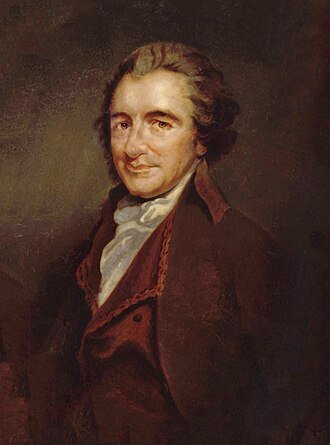
 AuthorThomas Paine1737–1809
The Age of Reason is a deist treatise written by Thomas Paine, the English radical and revolutionary who had taken part in both the American and French revolutions. Its full title, The Age of Reason: Being an Investigation of True and Fabulous Theology, states its purpose: to separate what the author regarded as a natural, rational and verifiable religion from the myths and fictions he believed had been added by institutionalized religion.
The work appeared in three parts, in 1794, 1795 and 1807. The first was drafted in 1792 and 1793, when Paine, prosecuted in Britain over the second part of Rights of Man, had taken refuge in France. Dismayed by the turn of the French Revolution toward secularism and atheism, he wanted to offer the French a defence of belief in a creator God. The second part was written after his imprisonment in Paris, and the third, composed in the United States at the end of the century, examines New Testament passages that quote Old Testament prophecies, though Thomas Jefferson advised him against publishing it and it did not appear until 1807.
The book holds that reason should prevail over revelation. Paine criticizes the corruption of the Christian Church and its pursuit of political power, denounces what deists called priestcraft, and rejects the doctrine of original sin, which he saw as a means of subjecting people to the clergy. By denying that the Bible is a text inspired by the divinity, he examines it as a literary work, with its contradictions and implausibilities, and he rejects miracles as unverifiable. Yet it is not an atheist text: it defends a natural religion and the existence of a creator God whose laws are manifest in the world.
Most of its arguments had long been familiar to educated elites, but the book presented them in a direct and irreverent style that made it accessible to a broad public. Its low price also placed it within reach of many readers. In the United States it was a great success and brought about a brief revival of deism. In Britain, by contrast, it met with hostility, since fear of political radicalism spreading after the French Revolution led the government to prosecute printers and booksellers who published or distributed it. Even so, its ideas inspired many British freethinkers, and its polemical tone has endured in later writers.
Themes
Other works by Thomas Paine
- Common Sense 1776
- Rights of Man 1791
Original Filopedia text based on Wikipedia (es) and Wikipedia (en) and Wikidata.