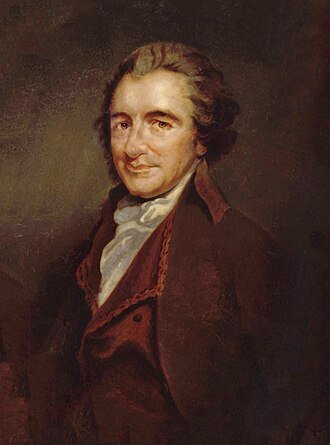
 AuthorThomas Paine1737–1809
Common Sense is a short political pamphlet written by the English-born writer Thomas Paine and published anonymously in Philadelphia on January 10, 1776, at the start of the American Revolution. Paine had lived in the colonies for only about fourteen months when he wrote it. His aim was to argue for independence from Great Britain and for the creation of a sovereign state governed as a republic. At that time many colonists still favoured keeping political ties with Britain, and even the idea of a republic unsettled a good number of them.
To reach the widest possible readership, Paine wrote in a plain and direct style, avoiding philosophical jargon, learned references, Latin and quotations from classical authors, which set it apart from the usual prose of the Enlightenment. The tone is biting and often satirical. Paine shaped the work like a sermon, drawing on the language and structure of the Bible and linking the cause of independence to the Protestant faith and dissenting traditions of the colonists, so that independence appeared as a distinctly American political identity.
His case rests on several arguments. The colonies gained nothing from their dependence, since the mother country sought only to exploit their resources and dragged them into Britain's European wars. Paine found it absurd that an island should rule a continent, and he held that reason and natural law demanded separation. He rejected the doctrine of the divine right of kings as having no rational basis, and he defended popular sovereignty and an effective democracy as the only reliable means of restraining abuse of power. He also criticised the constitutional monarchy championed by John Locke, which in his view still left too much power in the hands of the monarch.
The pamphlet had an extraordinary impact. Paine estimated that about 120,000 copies were sold within three months, and the text circulated in print, in handwritten copies and in readings aloud in taverns and meeting places. Some historians question these figures as implausible for the literate population of the time, but they agree that it was one of the most influential texts of the independence movement. The historian Gordon S. Wood called it "the most incendiary and popular pamphlet of the entire revolutionary era". Paine never profited from its success: he gave up his copyright and lost money on several of its printings.
Themes
Books to read
- Common Sense EnglishEPUB 172 KBRead online
Other works by Thomas Paine
- Rights of Man 1791
- The Age of Reason 1794
Original Filopedia text based on Wikipedia (es) and Wikipedia (en) and Wikidata.