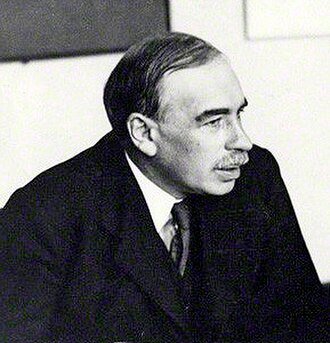
 AuthorJohn Maynard Keynes1883–1946
A Treatise on Money is a two-volume work by the English economist John Maynard Keynes, published in 1930. In it Keynes distinguishes between saving and investment and argues that when saving exceeds investment, a recession follows. He therefore concludes that during a depression the best course is to encourage spending and discourage saving.
Keynes did not attribute booms and busts solely to external, random factors such as sunspots. He held that economic episodes arise when savings and investment fall out of step. For Keynes, the true measure of a nation's prosperity is not its physical wealth, such as gold or silver, but its national income, and the most important feature of that income is consumption.
The book explains how recessions can occur, though not prolonged depressions, a problem Keynes later took up in his General Theory of Employment, Interest and Money. His monetary theory was refined in a sharp exchange with other economists of the period, above all Friedrich Hayek and Dennis Robertson. Keynes replied publicly to Hayek, accusing him of misreading his conclusions and of fixating on terminological details. The work is also remembered because John Hicks noted that it was the first economics publication to use the term liquidity, which he could not find in earlier works.
Themes
Other works by John Maynard Keynes
Original Filopedia text based on Wikipedia (en) and Wikidata.