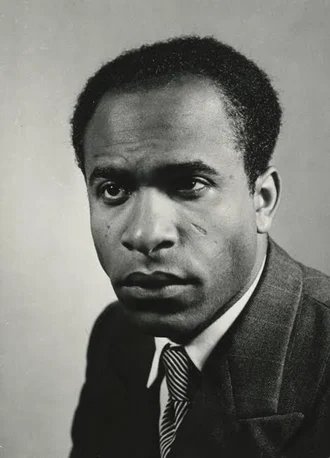
Frantz Fanon
1925–1961 · Martinican psychiatrist, philosopher and anticolonial thinker
Childhood and education in Martinique
Frantz Omar Fanon was born on 20 July 1925 in Fort-de-France, Martinique, then a French colony, into a middle-class family of mixed African, Tamil and white ancestry. His father worked as a customs officer and his mother was a shopkeeper. He was the third of four sons in a family of eight children, and two of his siblings died young, including his sister Gabrielle, with whom he was especially close. As a boy he was an avid footballer, and later organised matches for patients and staff at the Blida-Joinville psychiatric hospital in Algeria.
The war and colonial racism
After France's defeat by Nazi Germany in June 1940, Martinique came under the control of French naval forces loyal to the Vichy regime, led by Admiral Georges Robert. The war cut off imports and caused serious shortages, while Robert's regime repressed local supporters of the Allies, hundreds of whom fled to neighbouring islands. Fanon later described the pro-Vichy authorities as taking off their masks and behaving like authentic racists. In January 1943 he slipped away from the island during his brother's wedding and travelled to the British colony of Dominica to join other Allied sympathisers. After a local uprising in June 1943 overthrew Robert's regime, he returned to Martinique and enlisted in the Free French forces.
Combat and disillusionment
After basic training he reached Casablanca in 1944 and was shocked by the extent of racial discrimination within the Free French forces. He was posted to a base in Béjaïa, Algeria, where he saw at first hand the antisemitism and Islamophobia of the pieds-noirs. In August 1944 he took part in the Allied invasion of Provence and was seriously wounded by shrapnel in the Doubs, which kept him in hospital for two months. He received a Croix de Guerre for his service. When German forces were pushed out, the black soldiers in his unit were removed from their formations and sent south to Toulon, part of de Gaulle's policy of withdrawing non-white troops from the French army. Fanon wrote to his brother that he felt deceived and was sick of it all.
Studies in France
Back in Martinique in 1945, he completed his baccalauréat in philosophy at the Lycée Schœlcher and campaigned for Aimé Césaire, one of the founders of Négritude, in his bid for the French National Assembly. In 1946 he returned to metropolitan France to study medicine at the University of Lyon, where he also studied literature, drama and philosophy and occasionally attended Merleau-Ponty's lectures. He wrote three plays, two of which survive. He qualified as a psychiatrist in 1951 and trained at Saint-Alban-sur-Limagnole under the Catalan psychiatrist François Tosquelles, who drew his attention to the role of culture in psychopathology.
Black Skin, White Masks
In Lyon he wrote and published his first book, Black Skin, White Masks, in 1952. It began as a doctoral dissertation, Essay on the Disalienation of the Black, which was rejected; the philosopher Francis Jeanson, then a senior editor at Éditions du Seuil, gave it its final title and wrote its epilogue. In the book Fanon examines how racism and dehumanisation lead black people to internalise feelings of inferiority, since even those who speak the language, gain an education and follow white customs are still defined as the black man rather than as man. Jean-Paul Sartre remarked that the book was "the negation of the negation of the black man". Some critics have objected that it underrates the positive role orality can play as resistance.
Algeria and the war of liberation
After a year at Pontorson he was appointed chef de service at the Blida-Joinville Psychiatric Hospital in Algeria in 1953, where he stayed until his expulsion in January 1957. There he changed his methods, introducing sociotherapy to connect with his patients' cultural backgrounds, and trained nurses and interns. After the Algerian revolution broke out in November 1954, he secretly joined the National Liberation Front. He was obliged to treat both the French soldiers and officers who practised torture and their Algerian victims. He travelled widely across Algeria, mainly in Kabylia, to study the cultural and psychological life of its people, and in summer 1956 wrote his public letter of resignation to the resident minister, renouncing his earlier assimilationist outlook.
Exile, illness and death
After a brief stay in France he settled in Tunisia, where he worked on the editorial team of El Moudjahid and served as ambassador of the Algerian provisional government to Ghana, attending conferences in several African capitals. After an exhausting crossing of the Sahara to open a third front, he was diagnosed with leukaemia. He travelled to the USSR, where his condition briefly improved, and on returning to Tunisia he dictated the text that became The Wretched of the Earth, published posthumously in 1961. He visited Sartre in Rome for the last time and then went to the United States for treatment under the name Ibrahim Fanon. He died on 6 December 1961 in Bethesda, Maryland. After a state funeral in Tunisia he was buried in the Martyrs' Cemetery at Ain Kerma, Algeria.
Legacy
His political work is complex and controversial, yet it has inspired anticolonial liberation movements for more than six decades, and its influence reaches postcolonial studies, critical theory, feminism and liberation theology. Its importance was renewed in the late twentieth century, above all through the work of Edward Said. He was among the first to link psychopathology with decolonisation and to advocate community and institutional psychotherapy.
Key ideas
- Colonial alienation: colonialism does not only subjugate the body; it distorts identity and the colonized person's relationship with themselves.
- Black skin, white masks: the colonized adopt the language and values of the colonizer in order to be accepted, but in doing so internalize their own inferiority.
- Dialectic of Black and white: each pole depends on the other, and only a society without discrimination could overcome that relation of domination.
- Violence and decolonization: decolonization is a violent and transformative process that must aim at creating a new kind of human being and a different society.
- Social psychiatry: mental health depends on cultural and social context, so treatment must take the patient's community into account.
Where to start
Black Skin, White Masks is the most accessible entry point to Fanon. It blends historical analysis with autobiographical reflection to explain how colonialism and racism shape identity, language, desire and self-esteem among colonized people. The reader will find the core ideas of his thought without needing specialized training.
Next: The Wretched of the Earth. The Wretched of the Earth extends those ideas toward politics and the violence of decolonization, and is his most influential work.
Works in Filopedia
Curiosities
A remark that angered his editor
According to accounts of the period, Fanon exclaimed "Not bad for a nigger, is it?" during an editorial meeting with Francis Jeanson, who was offended and dismissed him from his office; Jeanson later earned Fanon's lasting respect.
A title suggested by the editor
Fanon's original doctoral dissertation, Essay on the Disalienation of the Black, was rejected, and he turned it into a book; the final title, Black Skin, White Masks, was suggested by editor Francis Jeanson.
Teachers and influences
Influenced by
- Jean-Paul Sartre 1905–1980
Influenced
- Andrea Dworkin 1946–2005
- Achille Mbembe b. 1957
Original Filopedia text based on Wikipedia (es) and Wikipedia (en) and Wikidata.