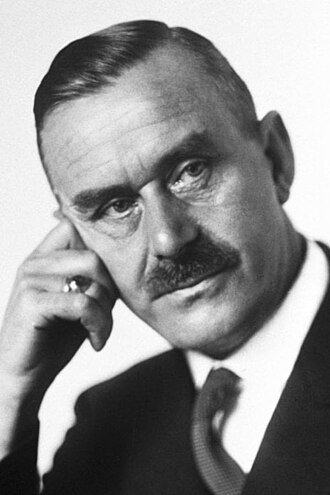
 AuthorThomas Mann1875–1955
Death in Venice (in German, Der Tod in Venedig) is a novella by Thomas Mann, published in 1912. It is one of the best-known works of its author, alongside Buddenbrooks and The Magic Mountain. Mann drew in part on his own visit to Venice in the summer of 1911, during a cholera epidemic, and on the memory of a Polish boy he had observed on that trip. The work first appeared in a limited edition, then in instalments in a literary magazine, and was issued in a trade edition in 1913.
The protagonist is Gustav von Aschenbach, a German writer in his early fifties, famous, disciplined and ascetic, recently ennobled for his artistic achievements and widowed at a young age. Tired and short of inspiration, he decides to take a holiday and ends up in a hotel on the Lido, facing Venice. There he notices Tadzio, an adolescent Polish boy of almost sculptural beauty who is travelling with his family. What begins as an admiration that the writer interprets as elevated and artistic becomes, little by little, an obsession he never dares to confess or express through gestures. Aschenbach follows the boy through the city, worries about his own ageing, and visits the hotel barber to dye his hair and apply make-up, until he resembles the grotesque old man who had once repelled him.
Alongside this, the novella portrays Venice as a city of heavy, decadent atmosphere. The authorities conceal the cholera epidemic so as not to frighten away tourists, while rumours spread and foreigners begin to leave. Aschenbach knows of the danger and, rather than withdraw, chooses to keep it to himself, since warning the family would mean losing the boy. His dreams, filled with Dionysian imagery, reveal the sexual nature of his desire, which never becomes physical contact or spoken words. The novella has been read in many ways: as an account of the conflict between reason and passion, between the ideal of beauty and degradation, and between self-control and surrender to impulse.
Its reception has been wide. Luchino Visconti adapted it into the film Death in Venice (1971), with Dirk Bogarde and Björn Andrésen, which won numerous awards. Benjamin Britten made it into an opera in 1973, and there are also a television adaptation, a ballet by John Neumeier and literary sequels, such as Luisgé Martín's Spanish novel La muerte de Tadzio. The work remains a touchstone for discussions of desire, ageing, and the relationship between art and life.
Themes
Books to read
- Death in Venice EnglishGutenberg
Other works by Thomas Mann
- Buddenbrooks 1901
- Tonio Kröger 1903
- Reflections of an Unpolitical Man 1918
- The Magic Mountain 1924
- Mario and the Magician 1930
- Lotte in Weimar 1939
- Joseph and His Brothers 1943
- Doctor Faustus 1947
- The Holy Sinner 1951
- The Black Swan 1953
- Confessions of Felix Krull 1954
Original Filopedia text based on Wikipedia (es) and Wikipedia (en) and Wikidata.