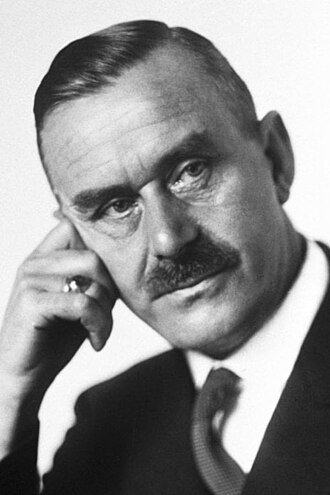
 AuthorThomas Mann1875–1955
Mario and the Magician is a novella by Thomas Mann, written in 1929 and published in 1930, first in the magazine Velhagen & Klasings Monatshefte and soon after by S. Fischer Verlag. It is set in fascist Italy in the late 1920s. Its first-person narrator is a German who spends the summer with his wife and two children in Torre di Venere, a small seaside town on the Tyrrhenian Sea invented by the author and based on Forte dei Marmi.
The holiday begins to sour almost at once. The resort atmosphere has become loud and nationalistic, and the family increasingly feels unwelcome: they are not allowed to dine in the veranda of the Grand Hotel, they are asked to change rooms, and after an incident on the beach the police fine them. They move to the modest Pensione Eleonora, but the spirit of the holiday does not return. Late in the season, when the more refined guests have left, a show advertised by the magician Cavaliere Cipolla arrives, and the family goes, drawn by the children's curiosity.
Cipolla is a deformed, prematurely aged man with a metallic voice, but of extraordinary will and power over others. What begins as a hypnosis act becomes a demonstration of domination over the audience, which resents him but does not dare to rebel. He hypnotizes several people, humiliates them and makes them obey, until the performance turns into a cruel scene in which Mario, a young waiter from the town, is ridiculed before everyone. Mario leaves the stage humiliated and soon afterwards shoots Cipolla, who dies on the floor. The ending is felt more as a release than as a tragedy.
The work is often read as a reflection on the hypnotic power of authoritarianism and on how readily a society submits to a charismatic leader, at a time when fascism was rising in Europe. Current criticism, however, considers this reading insufficient. Mann also explores free will, through a narrator who wants to leave and does not, and understands Cipolla as a figure of the artist's problem as it appears elsewhere in the author's work, a will that compensates for physical deformity. The novella was widely read and has inspired adaptations for ballet, opera and film.
Themes
Other works by Thomas Mann
- Buddenbrooks 1901
- Tonio Kröger 1903
- Death in Venice 1912
- Reflections of an Unpolitical Man 1918
- The Magic Mountain 1924
- Lotte in Weimar 1939
- Joseph and His Brothers 1943
- Doctor Faustus 1947
- The Holy Sinner 1951
- The Black Swan 1953
- Confessions of Felix Krull 1954
Original Filopedia text based on Wikipedia (es) and Wikipedia (en) and Wikidata.