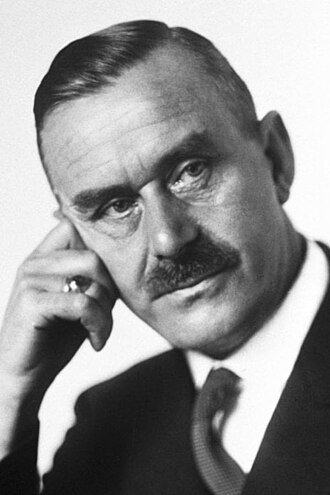
 AuthorThomas Mann1875–1955
The Black Swan is the last story written by Thomas Mann. He composed it in 1952 and 1953; it first appeared in the journal Merkur in 1953, and the same year S. Fischer Verlag published it as a book. It was included in the Stockholm complete edition in 1958. Like much of his late work, it is written in a parodic, deliberately ironic tone, with a prose that enjoys playing with language and literary conventions.
The action takes place in Düsseldorf in the 1920s, in a Europe trying to recover from the First World War and living between old customs and new artistic currents. Rosalie von Tümmler, a widow for many years, lives with her daughter Anna, a painter drawn to abstract and cubist styles, and her son Eduard, who is preparing for his final school examinations. Mother and daughter share a bond of affection and constant disagreement: Rosalie is an ardent admirer of nature and of all that concerns womanhood, while Anna is cool and rational.
The arrival of Ken Keaton, a young American hired to tutor Eduard in English, disturbs the household's balance. Rosalie falls for him and dismisses her children's objections. Soon afterwards she suffers a menstrual bleeding that she takes to be a miraculous rejuvenation, proof that the soul can prevail over the body. On an outing to Holterhof Castle on the Rhine, the couple slip away from a guided tour into secret rooms, and Rosalie confesses her love. The promised rendezvous never takes place: that same night the bleeding grows worse, and a doctor discovers an advanced cancer. Rosalie dies a few weeks later.
The story can be read at face value as an illness disguised as youth, but its deeper structure turns on the dialectic of life and death, one of Mann's recurring concerns. Rosalie, in her almost mystical devotion to nature, wants to outwit the law of ageing, and nature answers her with cruel irony. The black swans in the castle pond, the hollow oak in the Hofgarten and the crocus of spring work as symbols of that ambivalence. In her final conversation with Anna, Rosalie admits that death is a great means of life, and that her desire for love was not a lie but a gift.
The work has also been read as a commentary on society's attitude toward old age and mature female sexuality, and it has been compared with Death in Venice (1912) for its treatment of mortality and of a desire that never comes to fulfilment.
Themes
Other works by Thomas Mann
- Buddenbrooks 1901
- Tonio Kröger 1903
- Death in Venice 1912
- Reflections of an Unpolitical Man 1918
- The Magic Mountain 1924
- Mario and the Magician 1930
- Lotte in Weimar 1939
- Joseph and His Brothers 1943
- Doctor Faustus 1947
- The Holy Sinner 1951
- Confessions of Felix Krull 1954
Original Filopedia text based on Wikipedia (es) and Wikipedia (en) and Wikidata.