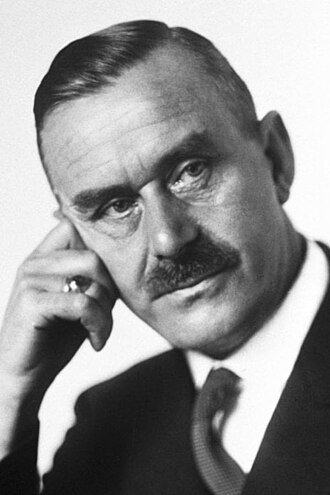
 AuthorThomas Mann1875–1955
Doctor Faustus, published in 1947 under the subtitle Das Leben des deutschen Tonsetzers Adrian Leverkühn, erzählt von einem Freunde ("The Life of the German Composer Adrian Leverkühn, Told by a Friend"), is one of Thomas Mann's major novels. Mann began writing it in 1943 while living in exile in Los Angeles, and the book drew on contributions from other exiled intellectuals of the first rank, among them Igor Stravinsky, Arnold Schoenberg and, above all, Theodor W. Adorno, whose influence shaped the passages on music.
The novel reworks the Faust legend within the context of the first half of the twentieth century. Its protagonist, the fictional composer Adrian Leverkühn, is a musician of exceptional gifts who, from youth, aspires to absolute artistic greatness. The story is recounted by Serenus Zeitblom, a childhood friend who writes in Germany between 1943 and 1946, as the country collapses under Nazism. Leverkühn deliberately contracts syphilis and, in a feverish state, converses with a figure of Mephistophelean traits who proposes a bargain: twenty-four years of creative genius in exchange for renouncing love. Whether that presence is real or imagined is deliberately left open.
The protagonist's life unfolds alongside the fate of his country. His last creative years are shaped by an obsession with the Apocalypse and the Last Judgment, and his culminating work, the cantata The Lamentation of Doctor Faustus, is presented as the fruit of that pact. In the end, before a circle of friends, he confesses the bargain as his mind gives way, and he spends ten years in an infantile state under the care of his relatives.
The book interweaves several layers: the history of avant-garde music, particularly Schoenberg's twelve-tone technique, of which Leverkühn is a kind of artistic alter ego; echoes of Nietzsche's life, especially in the syphilis and the figure of the thinker; the shadow of Beethoven in the protagonist's isolation and affective bonds; and the idea that Germany sold its soul to Nazism in exchange for a brief glory. Mann does not reduce the novel to political allegory: the predisposition to the pact arises from artistic life itself. Its reception has been intense and controversial, and it has inspired works such as Klaus Mann's Mephisto and Franz Seitz's 1982 film.
Themes
Other works by Thomas Mann
- Buddenbrooks 1901
- Tonio Kröger 1903
- Death in Venice 1912
- Reflections of an Unpolitical Man 1918
- The Magic Mountain 1924
- Mario and the Magician 1930
- Lotte in Weimar 1939
- Joseph and His Brothers 1943
- The Holy Sinner 1951
- The Black Swan 1953
- Confessions of Felix Krull 1954
Original Filopedia text based on Wikipedia (es) and Wikipedia (en) and Wikidata.